Showing posts with label Nobel. Show all posts

Sunday, February 16, 2025

Economics, 2024

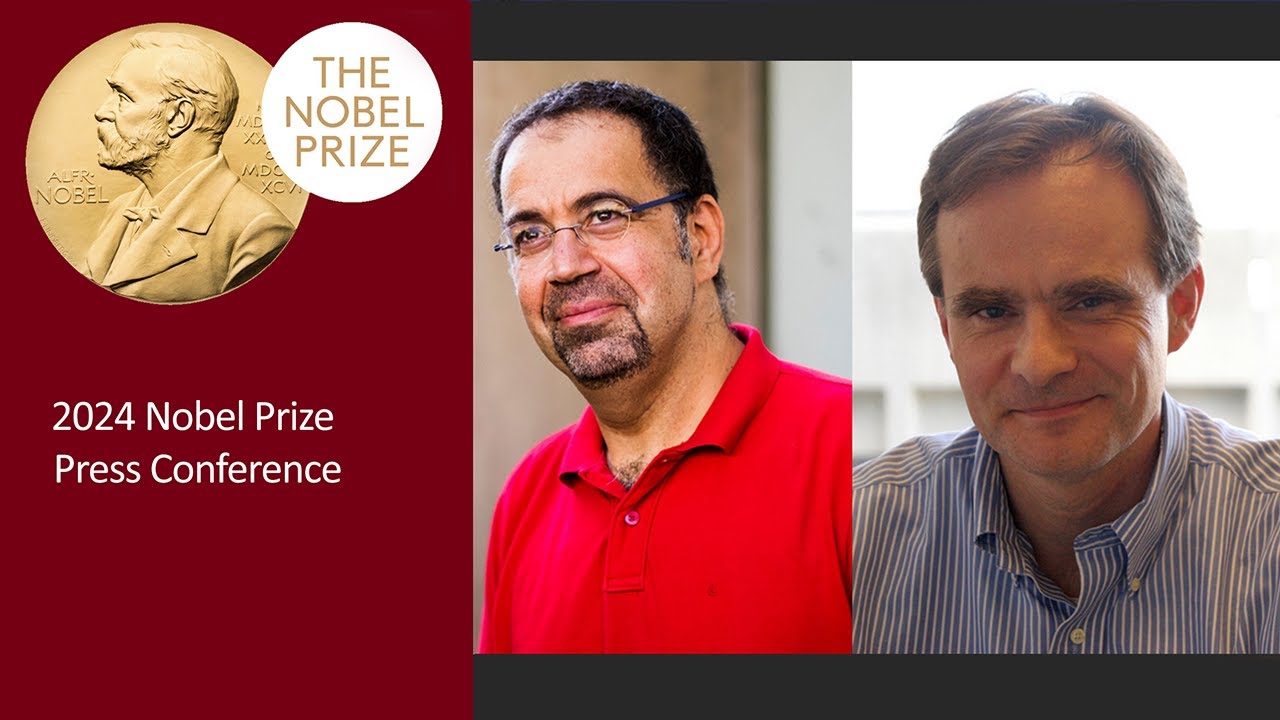
TL;DR -- Economics? About time. We looked at the science and medicine awards earlier. We have a category of Nobel as the posts are stacking up. A discussion of ChatGpt brought the additional Nobels to attention. The gist of the work is that GenAI/LLM will have minimal impact which brings up questions, such as, why all of the wasted effort and hype? 

--

We just made a "Nobel" category since there are so  many posts and there will be more. Our last post on the subject was about a family member starting an organization that supports excellence for high school students. The focus is mathematics as it will become more important due to computing's use (misuse) of the phenomenality and to its role as supporting science and technology. Other posts dealt with awards this summer that brought to fore an awareness of machine learning (couched as an misnomer, via "AI"). 

Now, economics? On Ln, we saw discussion of AI what was mature where a remark noted that an expert at MIT suggested that gains from AI will be less than 1%. Wait? Sounds like our sort of argument. Besides, one of John's graduate advisors was from MIT. And, John McCarthy was there. It, with Stanford and Carnegie Mellon, was a noted academic resource back in the '70s and '80s, prior to the downturn that was due to several factors. The term for this was "AI winter" with this concept being brought forth now due to the hype-driven scene that we have seen for two years. 
  • ChatGPT (Feb, 2023) -- We had written on AI for a long while, using AIn't for the most part. We are dealing with buckets-of-bits that are "warping our imaginations, clouding our intuition" (as we wrote elsewhere). But, notice that this post is about three months late, since OpenAI released their toy/tool in Nov of 2022. I had not been paying close attention to them. Since that time, there are several other posts. And, we have written elsewhere on the matter. Needless to say, in this interchange, we asked about Thomas Gardner. And, instructed it on what we knew then, or thought that we knew. Irony? At that same time, while I was looking at Wolfram's use (Mathematica) of ChatGPT (and others), some research work was being done via WikiTree (see Currrent Status). With that work, the TGS, Inc. foundations were shaken. We did not fall and are in a repair state. Sherborne, UK records show all of the kids, but Seeth, being born in England. Now, we are keeping to the notion of Thomas going back and forth and explain our reasoning. 
---

For now, here are a few links to material about the award. 
The unconstrained hype is normal for people. Newton (gravity and light guy) lost lots of money in some silly scheme. Bohr (more smart) said that the ca-pital-sino (our neologism) cannot allow winning without insider information. Oh? Yes, long ago, he said that. 

Too, where are the engineers? And, we will invoke KBE (knowledge based engineering) which allows the well-educated brains to qualitatively control the beasts of quantitative modes. GenAI/LLM for too long has adopted the aura of Einstein and his mathematics. Well, physics might win some battles with Ma Nature. It does not rule, yet. Nor will it. 

Computing? Out of mathematics via physics. Less than mature in so many ways. 

--- 

The Nobel's work can be used to analyze our progress over time as we consider those who got awarded and all of their compatriots, of their time. We will engage in that sort of discussion. 

Remarks: Modified: 02/16/2025

02/16/2025 -- 

Thursday, February 13, 2025

History of mathematics I

TL;DR -- While browsing on education and technology, we settled on the medical example and look at suggestions for High School work given an interest in Medical School. That leads to mathematics since the normal will be computational involvement brought to us by GenAI and its impact on modern culture. As such, there is lots to look for that is not available yet. That will change as mathematics is lifted to public view. 

--

This also could have been titled "computing and mathematics" given events of the past two years plus just what happened within the first month of 2025. However, the computer naturally comes out of mathematics (slide rule?, remember?, others?). That topic will be handled as needed. 

One focus that we have is supporting scholarly pursuits. In that sense and given our mission, much work has gone into the study of history and genealogy related to the experiences of the U.S. from early New England until now. We have supported the work of others in this regard through various means, mostly research. A goal has been to provide even more support of a financial nature. 

Lately, with GenAI now part of daily life for many, we have been increasing the attention given to technology; also, we consider that the U.S. and its 250th coming up fit into the various themes of governance of technology which seems to have been sorely lacking. With the emphais on computing being stronger now, we thought to look at people and their involvement especially as it pertains to the future. 

Education is a necessary theme. One result of GenAI's emergence has been that confusion has come about as to get involved or not. Many students adopted the technology early though overall there is no clear consensus on how such use ought to play out in an equitable sense. Now, after two years have lapsed, we see academic interest coming to fore. 

So, education needs to stay abreast of issues as well as adapt to new methods. We thought that it might be of interest to consider the experience and consquences of education with respect to a well-known field of operation, training of a medical doctor. As we started to browse, we ran into an interesting group and want to use them as a topic for further research. 
  •  The National Society of High School Scholars -- NSHSS -- "NSHSS is a distinguished academic honor society, committed to recognizing and serving the highest-achieving student scholars in more than 26,000 high schools across 170 countries. With access to valuable resources and a network of more than 2 million exceptional peers spanning high school to college and career, NSHSS scholars embody academic dedication and outstanding leadership in their schools, workplaces, and communities."
Our first encounter with their site was this post: You Want to Be a Doctor? Here is the Average Salary for Each Medical Specialty. So then, if we look at that discipline which is well-known, one would look to see how to meet the requirements for doing the work. We all know of the academic work after the undergraduate college experience: medical school (internship); residency; further study. What about pre-college? 

Turns out that there was a NSHSS post that goes into this as it is a very good example: How to Prepare for a Future in Medicine Early in High School. This post gives an example course load with 4-years of mathematics, science and a foreign language. It is a typical mix for a scholarly pursuit with the newer emphasis on AP courses which exposes the student to college-level material. One new emphasis is on getting into the ways of calculus. We touch upon that below. Also, there are many more resources for supporting this focus, including preparation for testing. 

---

One founder of NSHSS was of the Nobel family (Claes NobelCommemorative) whose prizes we started to pay attention to this year. Mainly, that was due to the Physics and Chemistry Prizes honoring computational work. The former was recognized in its association with mathematical physics. The latter included work sponsored by Google plus associated lab work. 

---

The past two years we have seen GenAI/LLM come into daily life with impacts that range from good to bad and with unknown ramifications. One thing clear is that underlying what we observe and talk about is mathematics in action. Hence, that topic must be brought to general attention including supporting material that will make specifics known at all levels as needed. This is a new task, essentially. 

For now, let's look at one aspect of mathematics that the NSHSS has on its list: calculus. Other courses include preparatory work as well as advanced material. But, we thought to point to a fuller picture than one gets where the algebraic view is associated with geometry which is on the Freshmen list. 

With computing and its advances? Expect that geometry will be a part of daily life. It actually is already in a native sense. Parts of and events in our 3D world are associated with Euclid's insights from over 2000 years ago. Before the latter part of last century, students studies analytic geometry and calculus, rather than calculus alone which avoids some of the niceties for the mathematician. 

The following link is to a chapter of the material for a class in the History of Mathematics at UC Irvine: 8 Analytic Geometry and Calculus. Neil Donaldson of Scotland (Edinburgh and Bath Universities) is a visiting lecturer whose material covers many of the topics that will come into the discussion. 

As we have mentioned, AI of late is not due to some critter emerging via heated circuits with their buckets of bits. Not at all. We are seeing, finally, years of effort at computing mathematics paying off with remarkable results. That some of these astonish only show how much we do not know but could and will know. 

Now, all of this material covers a range of fields in mathematics, all of it undergraduate in scope. Now, a first step would be to bring this into a College 101 format. Given the ability now for presentation via the web, one could then point back to the view of the undergraduate mathematics major and then to various graduate specialities. Yet, at the same time, material related to the application of mathemaics would be (or become) available. 

Now, the general public? Or the C-Suite? That is work to be done. Domain focus? OpenAI's success in playing around with mathematical games does not mean that human expertise and talent will become less than worthy. On the contrary, people ought to (and will) be the focus. We already have touched upon this at lenght but need to organize the material.  

Remarks: Modified: 02/14/2025

02/14/2025 -- Two days ago, OpenAI pushed out a view, based upon aesthetics - finally, with respect to their models: OpenAI Model Spec.  


Friday, January 10, 2025

Warning, on AI

TL;DR -- The Nobel's can be used to learn the history of science and to discuss choices made plus their ramifications through time. 2024 showed the Nobel focus on machine learning. In general, we can find many types of warnings that are not being heeded or even discussed. 

--

We mentioned the Nobel prizes this year, several times, example: Nobel Week. Because of the theme of some prizes in 2024, we finally paid attention. The Nobels can be used to trace the history of science since the Awards started so as to have philosophical discussions about choices. Why related ANN merely to mathematical physics? Wait, physics underlies everything else intellectually, one view says. 

Okay, fair enough. But the mathematical frameworks related to physics go far beyond those used so far in GenAI. This is an empirical matter that can be an ongoing discussion. GenAI came on the scene in 2022. We saw 2023 as a get acquainted time where sides of the issues were established. Cautions were thrown to the wind in 2024 as things went full speed ahead. Yet, the issues of hype continued to exist in public view. 

But, the use of ML (the AI of current mode) has exploded across the land. Repercussions are imminent (which timeframe?). Perhaps, we'll learn something. 

So, Scientific American provided us an opinion that express a "Warning about AI" which compares things to the bomb era and race. The author has a site and partners: Not just Math; Partnership on AI

Did the Nobel choices add to the necessary conversation? We have not seen yet anything positive, but it is still early. And the topic is here to stay. 

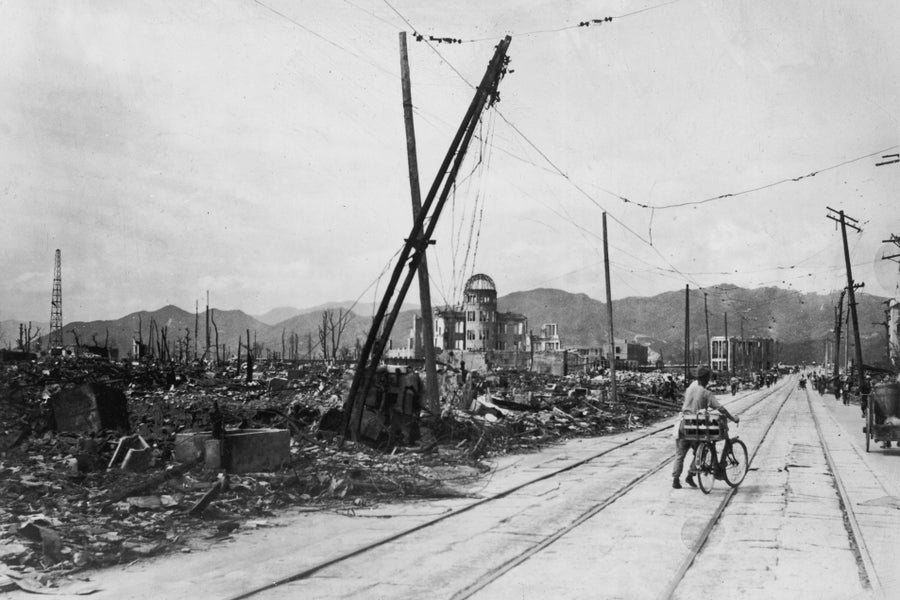
Along with its machine intelligence focus in the Prizes, the Nobel committee honored a person attempting to end nuclear war

Remarks: Modified: 01/10/2025

01/10/2025 --  

Friday, December 20, 2024

Nobel, Chemistry, 1901

TL;DR -- Significant to us were the Prizes for Physics, Chemistry and Medicine. In this post, we point to the 1901 award. As such, that is a good start with van der Walls and Hoff for physics and chemistry. 

--

We mentioned the 2024 Nobel Prizes earlier with more references to the Physics award which dealt with  machine learning. At the time, we emphasized the importance of the one for chemistry and for medicine. 

This post looks at the 1901 prize. It can be categoried as dealing with theoretical chemistry. After studying the advance of science and pondering what might bridge the gaps that are currently found in knowledge as we see observe the problems of technology, we settled upon theoretical chemistry as a central theme. Looking at the first Nobel prize in Chemistry is a good place to start. 

Nobel, Chemistry, 1901

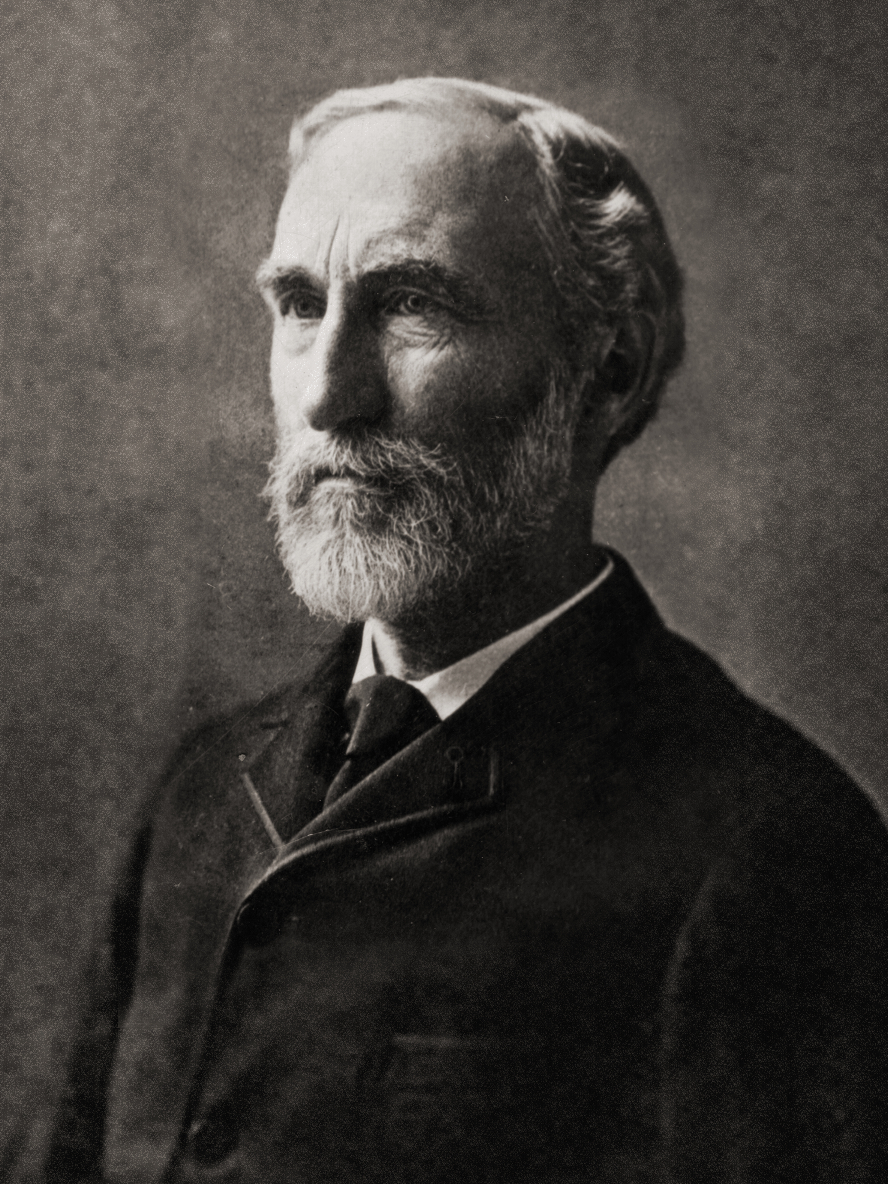
In Physics, van del Waals was the first Awardee for his work in thermodynmics but focused on his PhD thesis from 1873. Contemporary with van der Walls in doing the early work in thermodynamics was Josian Willard Gibbs who was an American and who we wrote of as a descendant of Thomas Gardner and Margaret Fryer through their son George. 

In Chemistry, Jacobus Henricus van 't Hoff (Wikipedia) was the first Awardee for his work in the "the discovery of the laws of chemical dynamics and osmotic pressure in solutions" and demonstrated the importance of physical chemistry

Tying back to the 2024 Prizes, we see that the mathematical aspects of physics and its kin has advanced tremendously with an acceleration that accompanied the growth, recently, of computing prowess. Both the physics and chemistry prizes acknowleged advanced computing which applied knowledge brought forth by studies in mathematical physics. 

Another topic that will be constantly at hand is the Philosophy of Physics. Wikipedia provides a good overview, except the material is rated as "original research" as an indication of value, improperly source information, and perhaps even viewpoint. There is also an article on the Philosophy of Chemistry (Wikipedia) which does not have the problem. They quote Friedrich Wilhelm Joseph Schelling as their first philosopher. One interesting twist? Is it thing or action that is important? That issue resonates to this day. A resolution was to accept both and make the situation the focus. 

BTW, philosophy of science is important by default, almost, to the upcoming discussions. 

Note: Stanford Encyclopedia of Philosophy (ChemistryModeling and Chemical explanation).  

Remarks: Modified: 12/30/2024

12/30/2024 -- See post (Nobel, Medicine, 2024) for link to those for Physics, Chemistry, and Medicine.  


Saturday, December 14, 2024

Josiah Willard Gibbs

TL;DR -- Josiah is a descendant and a well-known contributor to the development of a major theory in physics: thermodynamics. We will look at both his work and his pedigree. 


--

In our studies related to the Science of Technology, we will be running into many names. Some will not be American (such as Noether). Some will be American, and, of those, we will look for New England associations. The series on the Harvard Presidents is an example. We started this when we ran into a New Yorker article on James Bryant Conant. That got us to looking at all of the Presidents. 

Recall, one motivator for this work related to technology is machine learning (ML) masquerading as artificial intelligence (AI). But, in general, we want to follow the evolution of STEM along with the advance of the U.S. whose 250th is coming up. 


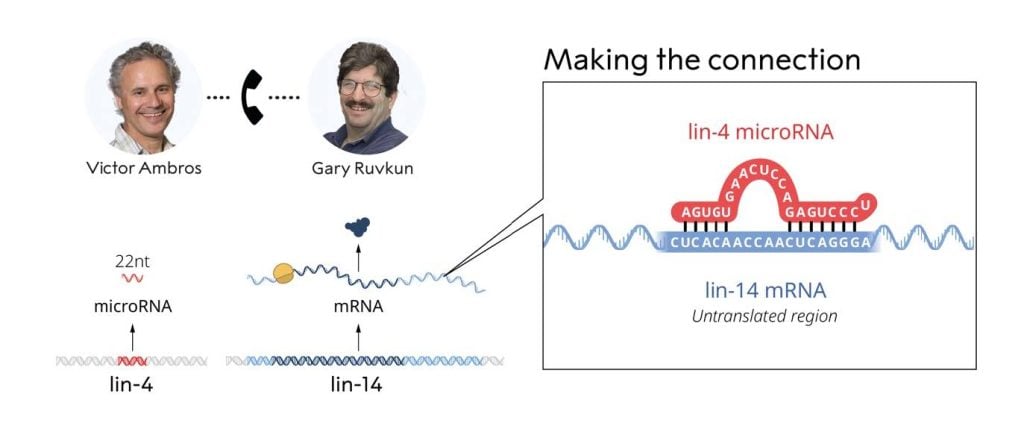
The Nobel prizes this year were a motivator,as well, with the focus on computation: Physics (neural nets); Chemistry (protein folding); Medicine (microRNA).  

Now, back to New Englanders, some will be descendants of Thomas Gardner and Margaret Fryer. We ran into one this week. Josiah Willard Gibbs (WikipediaWikiTree). How did we get to him? In our technology studies, we are looking at the foundations of science. In that regard, thermodynamics is important. There are many other types of dynamics. Right now, we are considering those related to science and engineering but will broaden the scope as we go along. 

A well-known treatise on the subject was written by Max Planck (archive.org). Planck references several prior researchers, such as van der Waals. But, Gibbs is a frequent reference. On looking further, we found his association with James Clerk Maxwell (well-known contributor to mathemattican physics) and one of his detailed books on entropy that published his experimental work: On the Equilibrium of Heterogeneous Substances. We will use this work to leverage several discussions about knowledge and machine learning. 

So, Josiah will feature in future posts. He is a descendant of Thomas and Margaret via their son George. He is mentioned in later edition of Dr. Frank's book (1933: pg 63). 

Postnote: It is fortunate for us that we can use a Thomas descendant to scrutinize machine learning along several frameworks in our technology research. As such, this focus will cover both the U.S. and European contributions, indexed according to the times of the Nobel prizes with Planck's efforts as central to the discussion. 

Remarks: Modified: 04/28/2026

12/21/2024 --  Added Josiah to the "Descendants of George" list. 

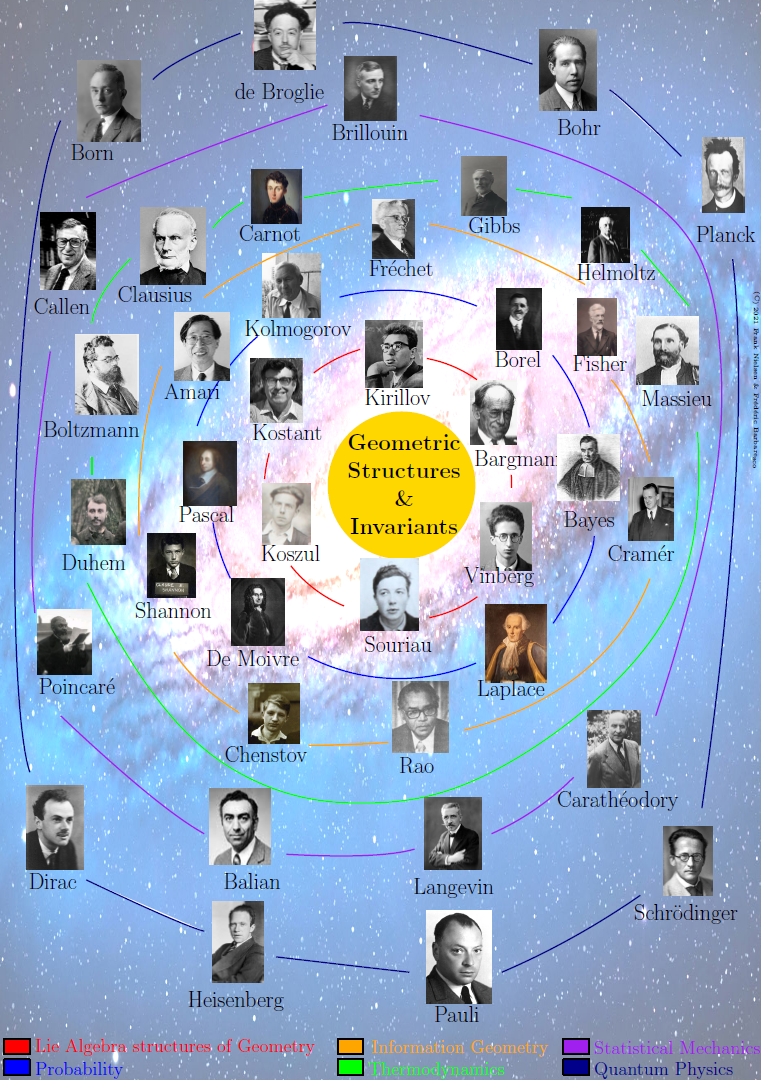
12/18/2024 -- Gibbs is on this graphic from the Geometric Science of Information site. 


01/26/2025 -- Gibbs was first in traisping through vector spaces: The Stargate Project

04/28/2026 -- Updated links and image. 

Saturday, December 7, 2024

Nobel, Physics, 1901

TL;DR -- Let's spend some time using the Nobel prize to track the history of advances in science. After all, people do the science. And, some factors related to people come out of genealogical and historical (cultural) studies. 

--

We have paid more attention to the Nobel prizes this year than ever before. This might become a habit since the 2024 prizes referenced, indirectly, the bugaboo of the modern world, AIn't. The Physics Prize was for machine learning; the Chemistry Prize was for protein modeling. In looking at the Nobel material, it seemed obvious that the material presented about the work of het honoree was remarkable. We can follow the prize over the year to obtain material for analysis.  

As an aside, we mentioned a Balch descendant who was a Peace Prize honoree: Emily Greene Balch. But, we need to get more particular. 

Looking at Physics, first, the inception of the prize was in 1901: Wilhelm Conrad Röntgen. Here is the link to the Award Ceremony Speech. There are many years to cover. 

With the 2024 Prizes for Physics and Chemistry dealing with computational approaches which is our technology interest, we have a natural categorical framework with which to start. We will not do a linear search but will follow some interesting parallels. For instance, the 1918 Prize for Physics went to Planck for his work in quantum mechanics. Who we have referenced him in several place. In 1922, Einstein got the award for his work with blackbody radiation in 1905. Einstein presented his relativity theory in the meantime; the committee felt that there was not enough proof for an award. We'll go more into that later. 

This thematic bit of research will cover a lot of ground. Well, with respect to machine learning, we are talking the sum total of knowledge that can be handled using computational means. 

Switching to the Chemistry Prize, we thought to look at how many awards dealt with the computational in Chemistry. We expect this in Physics. Wiley published an essay that lists prizes, both Physics and Chemistry, that will be of interest to us: The Nobel history of computational chemistry. A personal perspective. 

We looked an early Chemistry prize, 1910, which was for an 1893 thesis: Nobel Week. The theme was remarkable for several reasons, one of which is the history of science as it is unfolded through human effort.Johannes Diderik van der Waals (Wikipedia) showed that elements are molecularly the same as they go through phases. We will get more into that topic as we go along. 

A final note provides a summary by Gemini of Google via Chrome. After all, the Nobel committee opened this door; we ought (actually, must) to use it. 

Courtesy, Gemini of
Google via
Chrome

Remarks: Modified: 12/07/2024

12/07/2024 -- 

Monday, November 18, 2024

Nobel, Medicine, 2024

TL;DR -- This is the third of three gifts from the Nobel Committee. Starting with the math of machine learning and then with the chemistry work with proteins, there were heady responses with respect to the applicability of the technological insights. Ah, but wait. The Medicine prize brings us back to complexity and the reality of such. Now, one topic that will be continually on the table is this: has computing been a boon or a bane? 

--

This is the third post on the 2024 Nobel. The earlier two were: Physics; Chemistry

This post looks at the Prize for Medicine which reports on increased insights into cell regulation. 


These three can be thought of as gifts. Let's use them correctly. All things that can come from this will be discussed and utilized over the next few years. 

1. Physics - ANN and mathematical physics. I might say AIn't, but it is to the hype and misunderstanding (managers, something from nothing? - perpetual motion - need you a reminder?). Nope, the solution to the issues is right before us. It's that thing between the ears which has been allowed to go astray as it deals with complex things (yes, Mathematics - let's discuss). 

2. Chemistry - We see the hubristic side of Google (unfortunately so) tamed plus acknowledgement of lab work which is far from application (with respect to several proposed notions). At the same time, we see feedback into the thing mentioned in 1) with respect to interpretations (which is human and very much on display in the current mess) and changes that can come when empiricism works (busyness? your money focus is deleterious). 

3. Medicine - Back to reality. We now see that genetics is not under our thumb (note prizes the past few years). Insights to be gained there will play into better understanding of the computational (applied) mathematics that allows these freaky/magical moments (busyness people, look up Minsky - not Marvin, btw). Yes, complexity in another light (looking forward to seeing this generally known). 

And so, we proceed. Where we know that we are more than brain. What we need to look at further is that we can describe the necessary maturity for computation. If only, we can look at the past two decades and discuss what not to do (again) based upon our analysis.

Remarks: Modified: 11/18/2024

11/18/2024 -- 

Monday, November 4, 2024

Nobel, Chemistry, 2024

TL;DR -- We provide a link to Nobel Prize material that goes into the detail of the Chemistry prize and its computational framwork. 

-- 

Going forward,we can pay more attention to the material from the Nobel committeee with regard to the technology behind the selection. This image is from a page that looks at the history of the 2024 award for Chemistry which helps us document progress in GenAI (machine learning). 

How does AlphaFold2 work?

Advances using computational assists that reduce time and costs for experiments have been expected from the beginning, decades ago. What changes is the complexity. Fortunately, the domain of this research can have lab support as well as the use of physical experiments. 

We will discuss possible issues as we look at the topic. However, that there are those considerations on the table is beyond doubt. How we might attempt to rectify them is not so clear. 

Remarks: Modified: 11/04/2024

11/04/2024 -- 


Wednesday, October 9, 2024

Computational Chemistry

TL;DR -- Machine learning and its use of physics was the focus for the Nobel award. This was followed up with the chemistry award being given to protein research. This is a step forward for various reasons. Ultimate consequences are not really known at this time. Research deals with the future.  

--

Yesterday, we noted that the Nobel Prize for Physics in 2024 was given for work in machine learning. ML which is usually known as AI (artificial intelligence) deals with the technology of a computer systems taking as input huge streams of data and reducing these through various techniques into information that people can understand and use. But, this information can feed back into the computer model itself. 

The emphasis is on modeling which is accomplished through computational techniques. "computational" goes along with "theoretic" which deals with analytic and quantitative means applied to a field of study in order to effect desirable effects such as design, prediction and continuing analysis, generally in support of scientific endeavors. If one surveys the STEM discplines, one sees a huge influence of computational modes. With respect to some of the harder problems such as life and intelligence, one could very well suggest that theoretical chemistry will play a huge role. So, this is a necessary step; but, we have huge problems yet to resolve. 

Along with that of Physics, the Prize for Chemistry in 2024 was given to researchers who used a variant of ML from Google (AlpaFold). This work portends to future benefits that have been elusive using other means. Needless to say, the success is heavily dependent upon the researchers who are working now as well as the continually developing frameworks of their disciplines. 


A technical paper explains some of the details: COMPUTATIONAL PROTEIN DESIGN AND PROTEIN STRUCTURE PREDICTION. The following is a quote from the paper:

In summary, the achievements of David Baker, Demis Hassabis and John Jumper in the fields of computational protein design and protein structure prediction are truly profound. Their work has opened up a new era of biochemical and biological research, where we can now predict and design protein structures in ways that had not been possible before. Hence, a long-standing goal has finally been met, and the impact of this will have far-reaching consequences. 

As it says, this is research and applies to the future. We will look at some recent applications of the techniques and discuss the matters that relate. 

The use of AI is somewhat unfortunate. The work is an example of applied mathematics, computational modeling of such, people who are in the position to exploit the facilities in their work, and long years of work captured various ways as science has been doing for the past 200 years or so. 

AI deals with intelligence which we know is mostly associated with living forms. Now, we can look more closely at modeling these by using improved protein analysis plus a whole lot of other information. Like with physics which is strongly using normals in order to reduce problems to a proper scope, we will see this with other scientific domains. 

At we see with GenAI, what are the costs of this research in comparison with other work that is necessary, in terms of the resources used (say power), or the potential for misuse given our proclivity to not know how to manage complexity? 

Congratulations to the Laureates. Looking forward to watching things unfold. 

Remarks: Modified: 04/04/2025
10/09/2024 --  

Tuesday, October 8, 2024

Nobel, Physics, 2024

TL;DR -- Good old mathematics behind machine learning gets some respect. That is good news. 

--

New directions pend. We have talked AIn't for a while. There's no critter in the buckets of bits. There may be patterns. Now, the Nobel Prize folks say that this is physics and a result of its mathematics. 

Okay, that's great. We argued anyway that the focus ought not be intelligence which goes with life, and its study - biology, as far as we know. We stressed the mathematical connectsions, but having physics now in the game improves the chance of lifting awareness to things that matter. 


So, this post goes with our technology focus which we are trying to define and foster.   

Remarks: Modified: 11/18/2024

11/13/2024 --  Added Nobel Prize, to the name. 

11/18/2024 -- So, we now have Physics, Chemistry and Medicine, connected. Expect further discussions. 

Monday, August 5, 2024

Memory - present, past

TL;DR -- The cloud and such? What's the use? Science was an early motivation for the research and engineering. We're at a crossroad, somewhat. So, posts on technology themes will be a regular occurrence. 

---

Technology is the theme as it has given us a universal memory machine, somewhat. That is, computing and its cloud and the related trackers provide a seemingly endless memory. That digital ocean was one of the things used to train GenAI (ChatGPT, &c). Back in 2015, we had a post (Web/cloud presence) that brought up the choice for us all, ought what we do be forgotten? 

At that time, the cloud was 10 years old (we date it from GSA's decision that the US Government could use the emerging resource). We found out the other day, that Microsoft's cloud is used in the work of 85% of the US Departments. What comes to mind? Single point of failure, for one thing. 

Technology brings changes to which we have to adapt. That neverending affair can be a little offsetting. We do have choices in the matter which will be discussed on a regular basis. 

Today, let's look at keeping something that has value. 

The context is Physics and its rewards. The technology is a blog that quit adding new material a few years ago: Lady Science. There were two contributors from 2014 (see Archive - of their Monthly Issue). The first of these was titled "Delivery Room Drama" (17 Oct 2014). The last issue of a post was 8 Oct 2021. On browsing the site, we thought that it's good that this material is still around dealing with the topics of women, history and science. Some of the earlier posts were oriented toward art. One of the writers went back to school to learn the history of science. 

And, the blog got attention. Fortunately, it's archived at the Library of Congress. After a pause to look at our interest, we will discuss how we found this blog. 

---

So, our technology focus will make use of this material. Too, we like to do some comparisons related to time. In 2014 (see posts from that year), we were working in this blog plus our website which was hosted by a site using Linux as the OS. We started with blogger in 2010 which was picked up by Google. Having started our site with Microsoft, we moved when they went to Office365. After researching content vs configuration, we went with custom development. We have blogged about the technical aspects on the necessary choices and will organize a better summary review at some point. As, right now,we're looking at the future of software from several angles. We can all see the edges fraying. How did this happen? Can we recover without too much pain? Lots off questions. 

--- 

Also, we have paid attention to women and science in posts. See post on the daughter (Geertruida de Haas-Lorentz) of Hendrik Lorentz. We discovered her through the experiment of Einstein that she gave to a museum which represented the facility of small experiments. 

Today, in LinkedIn, we saw a post of The Nobel Prize group about the 1912 marriage of (Margrethe Nørland Bohr) of Neils Bohr. She was actively involved in his research and writing, but that work is not mentioned by the group. A comment provided this post: Crafting Quantum Theory: Margrethe Bohr and the Labor of Theoretical Physics. Their son got a Nobel Prize for his work on the nucleus. 

This blog represents several things. It's content will be apropos to the continuing discussions of STEM and its uses. Too, though, the structure of the content and the approach to the subjects are remarkable. As well, we like how it was designed for several reasons. Which of the various subjects to be addressed will be first is unknown. We're bringing the blog to awareness, in general. 

---

Our new project deals with a redux on AI along several fronts which deals with the timely problems that will emerge soon enough. 

Remarks: Modified: 08/05/2024

08/05/2024 --    

Sunday, March 24, 2024

Geertruida de Haas-Lorentz

TL;DR -- Running through links on a topic can lead to interesting finds. By a circuitous route, we ran into a colleague of Einstein who lived in the Netherlands and several other finds. Their work showed that inexpensive experiments can do the job. A related post continues our discussion on content versus configuration. 

-- 

Technology is our interest, and it's without limit. Today, we were researching relativity as it applies to some of the modern turmoils. Mainly, this is to set a basis for future discussion and work. In his book on the Evolution of Physics which he wrote with Infeld, Einstein discussed the rise of the modern views, from the perspective of the 1930s. 

One thing stressed was the importance of knowledge and the means for obtaining and managiing such. That applies across the board and usually was a human endeavor. Now, we have other wrinkles coming into sight. These are not new which we will go into. 

But, on reading material, I ran into the old topic of content versus configuration. Or, vice versa, as it's a two-way street. In fact, the TGS work has been important in following the ins and outs of technology as the web and its use became more sophisticated. Mentioning acquisition of knowledge? Mostly, that seems to be associated with the artificial. But, no, people need to  learn to. 

So, there was a hit on a search for a algorithm that pointed to a website (HyperPhysics) managed at Georgia State. The site uses Java and Javascript to provide demonstrations of algorithms related to research in Physics. It has a goal of providing information of a technial nature to teachs of High School Physics. The Georgia site also links to HyperMath which of the same approach. Both of them are great. 

Another link goes to Physics World which is all modern and mostly reporting. However, the articles are a great collection. One of them motivated this post. 

Given that this is Women's History Month, we wanted to feature Geertruida de Haas-Lorentz who provided an experiment to a French museum. It had been done by her husband and Einstein in 1915 and showed a connection between magnetism and "angular-momentum of electrons" using a simple device. Geertruida herself did experiments that tested Einstein's proposals about Brownian motion. 

Her father was the Nobel Prize winner for his theoretical work that supported Einstein's relativity research. 

This was Einstein's only experiment as his work was theoretical (and cultural). 

Back to content and configuration: old (This week's finds ...); new (Azimuth). 

Remarks: Modified: 03/24/2024

03/24/2024 --  

Tuesday, May 23, 2023

Literary Gloucester

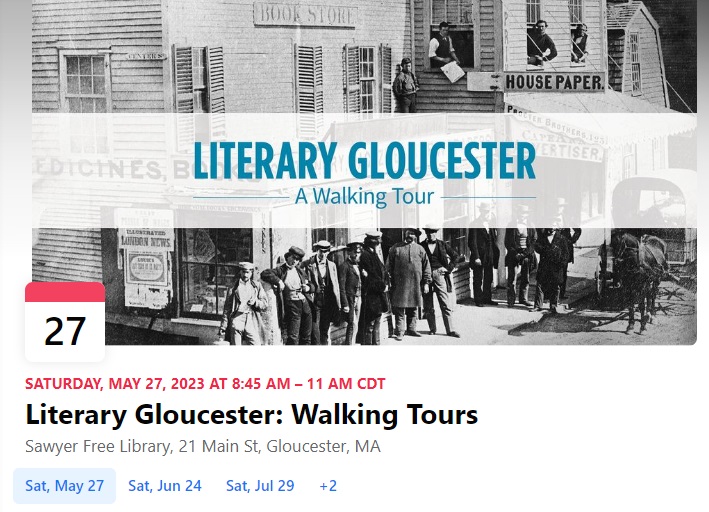
TL;DR -- Activities continue in Gloucester in commemoration of their 400th. Coming up this weekend is a tour related to literary activity that took place in the area. Familiar names were mentioned, so we went to look at our posts. 

--

We share this as a marker of the 400th of Gloucester which has been going on this year. With the warmer weather, a serious of tours are planned. One caught our attention as some of names have been mentioned in this blog. First, a quote from the site:

Gloucester has been home to great writers since at least the early nineteenth century when Judith Sargent Murray penned her feminist poems. T.S. Eliot, Nobel Prize winner, spent nearly every summer of his boyhood in Gloucester and themes of the sea often turn up in his poetry. Charles Olson and Vincent Ferrini maintained a poetic dialogue in the 20th century on just what it meant to be a good citizen. Add to these the authors who blew into Gloucester to write one work, like Rudyard Kipling and his “Captains Courageous,” Henry Wordsworth Longfellow with “The Wreck of the Hesperus,” or even genre horror author H.P. Lovecraft with “The Shadow over Innsmouth.”


The first name that comes to fore is Charles Olson about whom we wrote in 2014 and whom we mentioned a few times after that. T. S. Eliot had been mentioned as a friend of Ezra Pound. Then, we ran into H. P. Lovecraft as a possible subject late last year. H. W. Longfellow had been mentioned in the context of the start of The Atlantic. Too, he is related to Benjamin Wadsworth, former Head of Harvard. 

We will look further into the matter, starting with getting acquainted with the work of the Gloucester Writers Center

---

Note: See the post "In summary" with regard to pending changes in the stories of Thomas Gardner and Margaret Frye and their origins. 

Remarks: Modified: 05/23/2023

05/23/2023 -- 


Tuesday, March 8, 2022

Gairdner Foundation

TL;DR -- Themes become memes and endure. Technology assists, in ways we do not even think about. But, will. For good or bad, we have to look at matters related to progress and change. Looking back can provide a framework which offers types of insights that we need to hone. With respect to medical research, the Gairdner Awards foundation is an example of successful handling of a particular focus. We will be looking more at that. 

--

We have mentioned this organization a couple of times in the blog but ran into their work almost in the beginning. Early on, we had lots of questions about the name and the families and started to look at All things Gardner. 'Gairdner' is obviously close to 'Gardner' and other variants of the name. This family is from Scotland. What caught out attention, though, was their work in supporting medical research. From the start, we have had research as a focus. Initially, there was a lot to do to fill in what for what we didn't know and are still working that. 

Why? The more we find out, the more questions arise. Too, it is our experience that the U.S. plays an unique role in the world which might be associated with the Americas, in general. So, issues of history, culture, and family will continue to get attention (see post on Culture, History, and Technology). It may not have been apparent, but we see technology, in general, a being of prime importance going forward. 

We have had several post related to the theme of technology. Here are a few: 

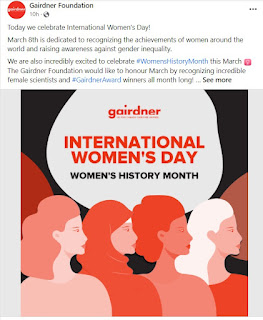
Now, getting back to the Gairdner theme, we were on Facebook and saw their hashtag post on Women's History Month. This is an image of the Gairdner Awards FB feed. 


They will be offering awards to women scientists, so we will stay tuned. 

From Streets of Salem: Books for Women's History Month, 2022

Remarks: Modified 12/22/2023

03/09/2022 -- Added book list. Of the categories needing attention, a "Magna Carta, technical" sits on the top. Not many make the effort to know: how all of this stuff works?; why it is like it is?; are there other alternatives?; and such. Rolling with the crowd, being controlled by those who can do so, lazing in the aura of gaming with its biochemical impacts, being impinged in unknown ways from the proliferation of material that impacts energy, and more. Research options abound. 

03/25/2022 -- Wikipedia article on the company. Ninety-seven Gairdner Laureates have won the Nobel Prize. ... Collected some information on James Arthur Gairdner (his parents, his service record). 

12/22/2023 -- THE FUTURE OF AI IN SCIENCE AND MEDICINE, talk at Gairdner Foundation, Oct 25, 2023. 

Thursday, August 13, 2020

Emily Greene Balch

TL;DR - Focus, descendants and their child of Thomas and Margaret.

--

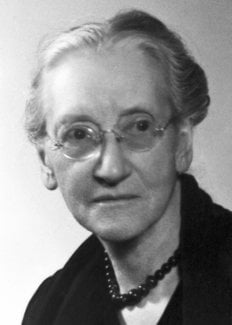
Emily Greene Balch received the 1946 Nobel Peace Prize.

Today, while reading book reviews in the WSJ, we saw Emily mentioned. The theme of the books being reviewed dealt with the upcoming celebration of the 19th Amendment of the U.S. Constitution.

Given her surname, we wondered if she was a descendant of Sarah (Gardner) Balch who lived in Beverly, MA. It turns out that she is, as shown in this WikiTree profile. Somehow, we missed her in our earlier survey and have added her to the list of Thomas Gardner descendants on Wikipedia.

Her parents were Francis Vergonies Balch and Ellen Maria Noyes. We will be looking at the family a little closer as well as getting more into this, and associated, subject matter. Her peers would have been of the generation of Ann's grandmother who was a Suffragist.

---

Of late, we have started to look at the U.S. generations with a New England reference. We know that Virginia was here prior to Plymouth. As well, we will consider the experience of other countries.

Emily would have been the 8th or 9th generation of the Massachusetts variety.

The 5th took the brunt of the Revolution with some of the 4th were still here as the older generation. It was the 7th generation that  began to obtain the rewards of the new country in established areas with others extending the country through trials of frontier living. We can look at the later generations, too.

Though it may seem that we are considering the good times, we recognize that major problems still existed over this time period whose solution would come later or is still pending.

Remarks: Modified: 0313/2022

08/14/2020 -- Jane Addams was the first American woman to win the Nobel Peace Prize in 1931. Her ancestor received his land grant from William Penn. Jane's parents moved to northern Illinois in 1844.

08/16/2020 -- On doing some research on Emily, I see that her ancestor's page has been edited. It is an example that we could follow: John Balch. Notice that these early Profiles are being driven by the Great Migration Project. We, the TGS, are helping edit the profile for Thomas (see right menu).

03/13/2022 -- Bryn Mawr was the alma mater of Drew Gilpin Faust.  It also welcomed Emmy Nother to the U.S. after her family fled the Nazi madness. Her brother went north to the Soviet Union and was killed by the powers that be.