Showing posts with label Backbone. Show all posts

Saturday, July 26, 2014

John Gardner and the Merrimack River

John Gardner was a son of Thomas and Margaret who was born at Cape Ann in pre-Conant times (1624). We have mentioned him a few times, such as for his roles in Nantucket, but he also was involved with Essex County and Massachusetts.

Gardner's map
In 1638, Gov. John Winthrop wanted a survey of the Merrimack River. Nathaniel Woodward (NEHGR, Vol. 51, 1897), a mathematician and surveyor, led the effort. John Gardner was part of the crew (Browne, G.W. (1906) "The Merrimack River: Story of its First Survey" Granite State Magazine, Vol. 1, p 133). Later, John annotated a copy of the map that was drawn using survey results.

See the image which can be found at American Indian Deeds (John's signature is on Section C) which was accessed from Salem Deeds.

---

John would have been young, of apprentice age, but this had to be a good experience. Dr. Frank (1907, pg 52) wrote that he "was first mentioned in the records of the 'General Court' at Boston" when the treasurer was "ordered to pay John Gardner ... for witness charge & carrying Goodman Woodward, his instruments to Ipswich."

This crew's map was used until 1652's effort at determining the northern extent of Massachusetts.

---

Note: I ran across the map while researching another topic involved with Ipswich. One intent is to gather as much as is available, and can be found, for each person of the 1st generation. Then, providing a persistent means for presentation is (will continue to be) on the table.  

Remarks: Modified: 01/17/2022

07/27/2014 - In 1638, there was a Harvard class in progress. From the viewpoint of effectiveness required for successful establishment of a community, one can, easily IMHO, ask whether John's experience might have some, a lot IMHO, advantages over the classroom discussions related to the number of angels on a pin head (sorry, had to write that)? This is an age-old argument, very much apropos to some modern problems. We expect to address this topic, and related topics, again. For now, look at Staloff's book (see preview at Google books): The Making of an American Thinking Class (oh Lord, deliver us). I have mentioned him several times in posts. I would take 100 Thomas' as backbones and brains over any intellectual as would anyone who has to deal with reality and problems that have to be HANDled.

06/06/2015 -- Given the day, an aside: Harvard contributed, relatively in size, manpower for both WWI and WWII. In some ways, it's astonishing that the likes involved currently (and their whole worldview) is supported by those who put their lives on the line daily and not by the ilk (we can discuss this from a historical view, please). ... The school has also just picked up oodles of money which has caused some controversy. None here, as the money could go toward making their upcoming 400th more pertinent to the American (and the dream for many - say, Magna Carta) experience, as a whole. ... Another aside: John Gardner, being young, may have provided the muscle for the crew, but that type of experience is missing from the lives of many who go to the supreme, supposed (similar ilk from all over the world is attracted), academic environment (say, for instance, a draft and real contributions thereby - see above). ... Finally, the view here is not colored by the fact of being an in-law to descendants of the first head (whole tale ought to be re-visited with all sides represented).

11/23/2016 -- Looking further into Dr. Frank's periodical, "The Massachusetts Magazine," we found R.A. Douglas-Lithgow as a contributor. He also wrote on Nantucket, and more.

12/12/2018 -- Fixed link to the map which came from American Indian Deeds.

01/17/2022 -- Right after the Revolution, the Head of Harvard was Samuel Webber. He was a Mathematics professor of note. Too, he did the surveying for the boundaries for the northern border (at the time) which was "recognized by the Treaty of Paris." This crucial discipline deserves more attention (search results - surveying). 

Tuesday, July 22, 2014

1st Governor?

This post goes along with our efforts at organizing all of the material that has been collected. For one thing, we expect to have the bibliography documented more extensively than what we have done so far. For many topics, we want to have an annals unfolding of the discussion. Gardner's Beacon, Vol. II, No. 6 - Issue, Post, is an example.

Today, I got to reading Hutchinson's work (Vol. I, Vol. II) that he finished after going back to England (as a Loyalist). He, of course, had Hubbard's manuscript which we almost lost due to fire (and riot). That would have been a real disaster for the Gardner viewpoint, as Rev. William Hubbard was the first to write (we will check this - was Cpt. Johnson, first?); and he had talked to all of the principals (Rev. William's work was published in the early 1800s over 160 years after he did his work). And, we can see how extensively Rev. William talks about the early years (as in, pre-1620 - see Gardner's Beacon, Vol. III, No. 1 - Issue, Post).

Let's look at one little item.

---

If one asks the question (Who was the first Governor of Massachusetts?), the most general answer will be John Winthrop who came over in 1630. Others, who might be more considerate of specifics, will answer John Endecott since he had a Royal charter in 1629. For more information, look at Wikipedia which has a nice list of colonial governors of Massachusetts.

Now, considering Plymouth, one can add John Carver at the top. However, what about George Popham? The Popham effort was successful in many ways and was thirteen years prior to the advent of the Mayflower Compact.

Then, we get to Ferdinando Gorges who supported Popham. He, and his son, Robert, were involved with several attempts.

We must not hold that they moved locations against them. That was the reality in Virginia, too. And, the Cape Ann crew moved.

Now, speaking of which, some might say, Roger Conant. This is mentioned in the family book (note that this link goes to their discussion of what we called Margaret's house - Gardner's Beacon, Vol. II, No. 4 - Issue, Post - Note: there is no mention of Thomas Gardner). Rev. William talked about Roger's lament of being ignored (-- future post -- this quote plus the late 1800s meeting that included the noted descendants, such as William Crowinshield Endicott, Jr, Henry Cabot Lodge, and others).

---

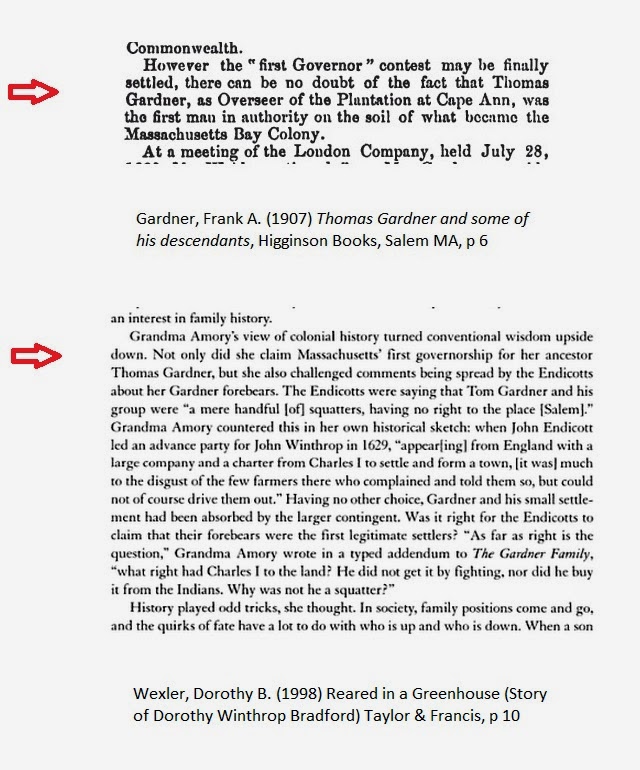
Now, in his book, Dr. Frank touches upon this, very briefly. But, in a section of Vol. II, No. 6, there is a look at the original source: Elizabeth Gardner Amory. Elizabeth's granddaughter, Dorothy Winthrop Bradford, writes about discussions with her. The image is from the book, Reared in a Greenhouse (preview mode at Google books) by Dorothy B. Wexler.

The time frame to which Elizabeth refers would be (say) post-US-Civil War. Elizabeth claims to have been the first to make this statement about the first governor. Her discussion about the matter is on page 10 (see image).

---

This little example is one of many. The recent book about how "invisibles" hold the world together offers a few modern concepts that can be useful as we proceed with further analysis (more later - but, there is no shadow nor is there any lament).

Remarks: Modified: 03/02/2019

07/22/2014 - Captain Edward Johnson published, in London, in 1654. His book was redone, in Andover, MA, in 1867 (this is in the collection for the bibliography). ... How could I not mention Higginson whose comment about Endecott's house lives on?

07/23/2014 - Read a little more of the book. Interesting. Added Elizabeth to the descendants list (Wikipedia, which has a page for the Dudley-Winthrop family). This list will be getting more attention; the last exercise got rid of stale and suspect links. We will reorganize (with the intent to foster analysis and discussion) and add more descendants (we need more of Miriam's progeny, for example).

01/19/2015 -- Maine History Online: Popham and Gorges.

03/02/2019 -- We are building an index of images at our portal to truth

Sunday, March 2, 2014

A new science?

Context: Richard and Bosworth

---

It occurred to me, as I was researching material related to Cape Ann and Thomas Gardner, that I ought to explain one of our interests. We can use genealogical forensics, as a loose example but a not weak analog (reminder - we are more than a few steps removed from fictionalized history - which, by the way, is a respectable field. How else can we get the movies, etc., out for popular consumption?).

Now, let's use the recent case related to Richard III (notwithstanding that some proposals have been found to be without merit) as it is an example of another type of forensics, namely anthropological. The image shows the results of a Google search on the subject of the reconstruction that was done from the remains that had been found and identified as belonging to King Richard III. By the way, The British Museum has an exhibit about this discovery.

The reconstruction looks a lot like what we saw with the portraits (see one of Wiki's image). So, one might consider that it (see the circled part in the image) was factor in the work. After all, how many Brits would not have Richard III imprinted on their psyche?

However, consider that similar efforts can be done with much fewer pieces. Too, as we know, a lot can be said about an individual from a small collection of data, sometimes (that being said, "big data" peoples, your aggregates of me, and many - most? - are way off base).

---

Before we go further, I need to point to the Forensic Genealogy Institute with whom I have no association. I am a private person, doing gentleman science - let's talk about that (in company of Faraday and a whole lot more). Disclosure: I am not a genealogist, historian, and a number of other things. What I do know are mathematical modeling (especially that which is computationally framed), many of the liberal arts and sciences (does that date me?), some military affairs, business/economics/finance, and a whole lot more. Actually, the best description would be autodidact who has broad interest. Too, I have known Gardners for almost half a century.

By the way, I have mentioned anceSTORY, before. The name has a lot of meanings. Yes, there are the dull details of the past. Too, there are those things that are known (and some were very clamorous - you see, people haven't changed much - I prefer Teddy's walk softly adage) and written about. Is that not history? But, then there is "being" (the larger story that is not captured by historical accounts - but, that is rectified now and again, see Joseph Hodgkins, as an example, albeit that McCullough could start with letters -- don't forget, though, that we can get to Heidegger, et al, to boot). That is what we're trying to capture.

---

Needless to say (but I will anyway), we must start with what we know. That means, in the real sense of science, what we have found out so far. In the case of Thomas Gardner (and Margaret), there does seem to be a whole lot of holes to fill in. Looking into expanding the base of knowledge is one task. I have only been at this four years, but I do not see evidence of any concerted, long term, effort to fill in the pieces (if I have missed something, let me know).

Too, though, would be to fill in pieces (using arguments of various strengths) as best we can using modern means. How effective this type of effort might be will become apparent as will its benefits as we go along.

Naturally, success will be best ensured if the brain is engaged during the exercises.

Moral: People were. That they (or information about them) might be acceptable to genealogists, or not, does not change the truths of their existence nor the reality of their continuing influence. Ought genealogists take lessons in how hubris is always just around the corner? As in, genealogy might help "flesh out" the truth; it does not define such.

Remarks:  Modified: 07/12/2016

03/03/2014 -- New science? Yes, bringing memes (and more) to the fore in the discussion. In the terms of Thomas, his progeny has a wide sweep, including the step-progeny. ... Of course, genealogy can apply to more than biologically framed lineage. For instance, mathematicians have their "ancestors," know about them (and their contributions), and honor them. What other field does that? My mathematical pedigree: Galileo Galilei (1585), Vincenzo Viviana (1642) Isaac Barrow (1652), Isaac Newton (1668), Roger Cotes (1706), Robert Smith (1715), Walter Taylor (1723), Steven Whisson (1742), Thomas Postlethwaite (1756), Thomas Jones (1782), Adam Sedgwick (1811), William Hopkins (1830), Arthur Cayley (1864), Andrew Russell Forsyth (1881),  Edmund Taylor Whittaker (1895), G.H. Hardy (), Edward Charles Titchmarsh (), Andrew P. Guinand (), Lucio Arteaga (1964), the blogger (). I took it back to 1585 since that would be co-temporal with Thomas and his parents. Too, note that the ancestor is an adviser or mentor or tutor. This brings to mind that a meme'tic look at descendancy would consider the influence of step-child-ness. I have found many of these relationships. For instance, for Thomas and Margaret, retired Supreme Court Justice Sandra Day O'Connor is a step-descendant. Thomas Dudley has a slew of step-descendants as do many due to early deaths and re-marriage being so common.

03/24/2014 -- Read, recently, a review in the WSJ (Book Review, March 7, 2014) about the work of Anthony J. Martin, a paleontologist. There was much discussion about determining dinosaur look and behavior from minimal evidence. That is, even footprints can be used in lieu of bones. The key, of course, is being knowledgeable enough to extrapolate from the small set. Too, there is information in the limiting factors. ... We can similarly reconstruct a scene from the past, with care, so as to be able to look at it from our later advantage point.

04/25/2014 - Genealogy almost seems to say: without papers, you (and your ancestors) do not exist. We know that this is silly thinking (albeit, probably not recognized by those who do such). Attempts at extrapolation (like, what was over the pond for an ancestor prior to their departure) or interpolation (filling in missing pieces) ought to be given more credence; that is, such attempts are more than mere science fiction or fictional history. Why? Ichnology allows grand portraits from seemingly minimal amounts of stuff in hand. Of course, the discipline has known rules. Also, from time to time, something comes about that affords verification (and calibration). The same techniques could be applied to the ancestral realms (and has been, again, in the fictional form). So, that is something on our plate, discussion of such methods and of their use (with demonstrations).

08/19/2014 -- Put in links to the WSJ review of Martin's book (see 03/24/2014). Also, link to ichnology's use. Now, with regard to genealogy, biology, and sociology (etc.), we will be getting back to the discussion, in particular the interplay of memes and their analog.

10/13/2014 -- Tabula raza, and more, will be of concern.

07/12/2016 -- Added context at front of the page.

Saturday, March 1, 2014

The glory that is Cape Ann

Did we miss something? Captain John Smith came over to New England in 1614/15. We're only two months into this period, so there is still time for Cape Ann to celebrate.

Yes, Cape Ann was named after this exploration.

Celebrate? Yes, in terms of the 400th anniversaries that will string along keeping New England in a jolly spirit for many years to come. The parties this time will make the 300th pale in comparison. However, our 1st cousin - Dr. Frank A. Gardner - was there for the Salem festivities.

---

For some reason, Cape Ann does not get the attention that it deserves. But, we can start to pull the research together now, 2014, as part of our effort at remembering (and honoring) what went on there in that seeding place.

The crew lead by Thomas Gardner got to Cape Ann about ten years later as part of a commercial fish and plantation effort under the auspices of the Dorchester Company which was headed by Rev. John White. There are connections with White and Conant. How Gardner relates needs further study.

In essence, we know Thomas and Margaret through their progeny.

One thing that would have been accomplished the first year was erecting the "great" house which would have been ready for their first New England winter. This house was later moved to Salem on the order of John Endicott.

John Winthrop beer'd and dined in this same house on his arrival at Salem in 1630; at this event, he enjoyed strawberries that had been picked that very day in Cape Ann (per his journal).

---

The next Gardner Beacon (Vol. IV, No. 1) will take a Cape Ann focus, especially in the period prior to the exodus. By the way, Thomas showed character when Roger showed up.

Many write of the Dorchester crew, under Conant, leaving that area to go to the area that became Salem. However, left at Cape Ann was the house and their plantings. Too, the distance is minimal. It would make sense to consider that Thomas remained active at both places. In the Salem area, he would have been involved with the settlement. In Cape Ann, he would have kept the house and the plantings in order. In fact, harvests at Cape Ann would have been brought to Salem.

We have no note that Conant found starving people at Cape Ann when he showed up. Rather, those there were boisterous and contended well with their Plymouth neighbors. In essence, the crew was fit and sound. Now, we know that they did not succeed in getting beyond subsistence. Hence, Rev. John White's Plea will follow us forever.

Thomas' name does not appear with the planters who were named explicitly (see Written out of History). Some have tried to enlarge the list (see Phippen plus). There was an effort before the 300th to form an Old Planters' society.

On further look, though, one might argue that Thomas did not have the cloud over his head that worried Conant and his guys. We know that he was there as Endicott refers to him in 1629 as Mr. Gardner.

---

But, we have other unknowns from the crew. For one, John Tylly needs some attention. If we take Phippen's list, for instance, we ought to document each of those guys and their families. Some are already well-studied (Woodbury, Balch, Trask, ...). For all, we need to create a lasting presence through publication and discussion.

Remarks:  Modified: 09/28/2014

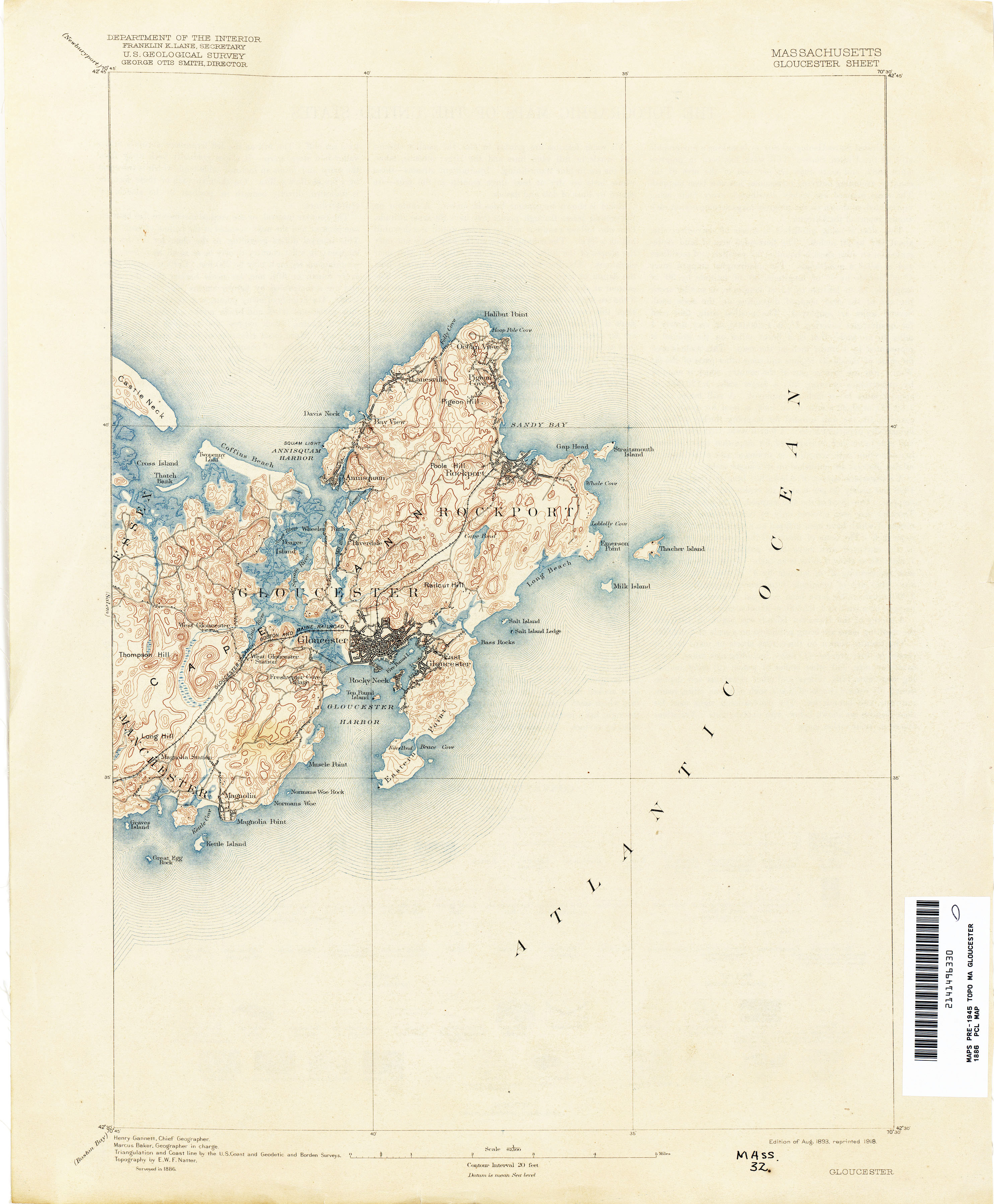
03/02/2014 -- Added piece of a topological map from 1886 (courtesy University of Texas).


03/18/2014 -- More thoughts on Cape Ann, Thomas and Margaret, and, not least, strawberries.

03/23/2014 - Cape Ann featured in Beacon Vol. IV, No. 1.

09/28/2014 -- A week ago, the record for the marriage of Thomas Gardner and Margaret Friar was discovered in Sherborne by John Cook of Minneapolis, Dorset files. This sets a type of focus. Looks as if some transcription work might be in order.


Monday, November 4, 2013

Dorchester Company

This company (and Rev. John White) is the focus of the next issue of Gardner's Beacon. There is a lot to be said for the company as many have weighed in with their views. It might be interesting to collect some of these here, whether or not they mention Thomas.

Too, research, and summaries thereof, needs to take a broad scope, probably wider and deeper than that taken by the Great Migration project. Such work will take some time; priorities have not been set. Right now, the thing is to gather material (even those that are, might be, of lessor value). So, the bibliography will continue to grow (we'll have a section for material from websites). This time around, ought we have a Dorchester Company subsection? 

As well, most of the material that we use will be accessible on-line. Library work will occur as time permits. Or, I ought to mention, work will depend upon having access to material. From what I've seen, the Boston area is loaded with gems (need to spend some time there); perhaps, someone in that locale will contribute (as John Goff did earlier).

Some sites recently encountered are:
  • answer.com - This site has a nice little overview with interesting sources. One thing mentioned is that several men were left to over-winter in 1623. When did Thomas arrive? Then, or the next spring? By the time that Roger arrived in 1625, the headcount was fifty persons or so. 
  • Salem Focus - The site deals with Salem. The particular PDF presents a story, in the early chapters, about the Cape Ann/Salem crew that was written by Richard Scott. The author starts each chapter with a year-event tidbit. Nice, as these can help motivate the look back in annals format. Governor Roger figures heavily. Governor Thomas has a mention or two. John Balch and a few of the other "old planters" have roles, too. Up to Chapter 30 (covers the period of 1661-1674) deals with the early times. 
  • Two books of interest: Vickers (1994) - Farmers and Fishermen: ..., Staloff (1998) - The Making of an American Thinking Class. In terms of the first, there is a nice discussion that helps to think about the motivation for the Cape Ann crew's configuration. The second? Ah, yes, the class that can do nothing but split hairs (for whom the farmers and the fishermen labor - how did this come about?). Ah, why there is a backbone series.   
  • ...
We will be adding to this list as we find interesting things related to the theme of the issue.

Remarks:  Modified: 03/21/2022

03/21/2022 -- Further on the Company. John Tilley's father was an investor. 

08/29/2016 -- More on Cape Ann, 1623.

11/01/2013 -- When we get a few things collected for the Dorchester subsection of the bibliography, we'll put a notice here. 

11/06/2013 -- While working on the next Beacon, I ran across some books. The one by Staloff was timely; imagine, I was wondering why the backbone series? Has the talented set ever allowed the lessors to have some semblance of a good life? Oh, you say yes? Winthrop, et al, were against this from the beginning. The stalwart of what could be (or could have been)? Thomas Gardner, of course.


Monday, December 24, 2012

No shadow over Thomas

I'm researching for the next Beacon issue which will have a brief timeline of the lives of Thomas and Margaret (it does a grand sweep of their times and after all the way to today). Hopefully, it'll point to areas where we'll focus effort in the future in order to expand upon the theme so as to leave the proper legacy.

I can thank Rev. Felt for phrasing some thought (read today) that I've had for three years in regard to Thomas (see Backbone series). That is, Felt gave me the proper concept to use. You see, how is it that there is such a lack of information? How can all of the written literature be so sparse in regard to his life over all of this time (from the beginning down to recent publications)? Even Anderson, et al, (Great Migrations) seems to write begrudgingly.

The below image is taken from Thornton's (1854) The Landing at Cape which tries to document the experience at Cape Ann (which has a bunch of unknowns). This book references Thomas only once as the plantation overseer, with Tylly, at Cape Ann. And, it is in the beginning, as in, pre-Conant. Other than that, there is nothing (based upon quick scan - so I may have missed something - the issue would remain, even so).

---

Aside and disclosure: The wife of the blogger is a direct descendant of Thomas and Margaret, however she is also descendant of Conant and others of the old and new planters. One might say that I'm continuing Dr. Frank A.'s argument about the injustice, in general. We'll get to that in the Beacon issue.

---

Felt writing
about Conant
Felt is talking about Roger's continuing displeasure at his treatment. But, the dear guy ought to have considered his treatment of Thomas and Margaret (he got the house!). The image quotes that Roger "retained a conviction of the great injustice done to him, even in his old age, and he could not refrain from reference to the neglect and ingratitude" referring to Endicott's arrival.

Notice that Felt says that "the new charter cast a shade upon Conant" which implies his followers (Balch, Palfray, Woodbury, Trask). A 1999 talk on the old planters of Beverly (we'll use this in the Beacon issue) said just that: Conant and his followers. These people worried that they might have been enslaved with the change in the power structure. It was so troublesome that Craddock had to address their worries, explicitly. Too, they were given the land in Beverly in order to bolster their spirits, so to speak.

And, old Thomas? Cool as a cucumber (as I've said, a guy who was effective, knew himself, and was the chief manifest'er of what was to become the American -- you think that London, et al, liked this?).

Now, none, nor any incident, that I can see, cast a shadow over Thomas. References to him imply dignity, respect, and more. On the other hand, he was ignored in writings, perhaps to put him in his place, as if that could happen.

Too, Thomas' stance was of the true American that we were to see develop over the succeeding centuries. One attribute of that stance was to be distant from the Churches (yes, plural -- ah, we can go on about that ad infinitum, but won't). Thomas was no follower; his blood and pedigree prevented that.

Now, too, his sympathy toward the Quaker thought, and the fact that his last wife was of that faith and that some of his sons were, to boot, talk of a mind that encompasses the shebang (put it this way: the every man view with both breadth and depth -- the latter, of course, meaning all classes -- those higher casting a shadow over the lower - hey, only those that you allow can cast a shadow over you). Yes, the Quakers were forward thinking and exhibited more than any a spirit of inclusiveness and peace (we'll have to get back to John Goff's take on King Philip -- we overlook, too much, our mistreatment of the American Indians - starting with whom? Endicott?).

However, we do not to want steal thunder from Gardner's Beacon. These topics all deserve careful study so that going forward we can have the proper view and respect for this UNKNOWN couple. As it says: honor thy father and thy mother (albeit transitively if necessary).

Remarks:

10/13/2014 -- Tabula raza, and more, will be of concern.

03/28/2014 -- See Vol. IV, No. 1 for a discussion of the movement from Cape Ann to Salem.

11/06/2013 -- While working on the next Beacon issue, I ran across some books. The one by Staloff was timely; imagine, I was wondering why the backbone series? Has the talented set ever allowed the lessors to have some semblance of a good life? Oh, you say yes? Winthrop, et al, were against this from the beginning. The stalwart of what could be (or could have been)? Thomas Gardner, of course.

09/09/2013 -- Forgot to update this earlier. But, the post related to Gardner's Beacon, Vol. II, No. 6, discusses that Thomas had no shadow over him as was feared by some old planters (would Dr. Frank, today, still want to include Thomas in the group?).

06/15/2013 -- John Farmer wrote that Thomas was from Scotland. Origins are, and will be, a focus.

03/02/2013 -- This may have appeared in another post, or Beacon. However, we'll repeat the thing here. When Thomas took the freeman oath, that is, that year, he was voted to the General Court with Hathorne (see above, another great-grandfather) who was a swashbuckler. It is interesting that Thomas, after that, kept a more local focus. There may be many reasons. But, getting up close with the clamorous ones may not have fit his mindset. You see. Throughout history, certain people get written about. Yet, in any situation, there are teeming amounts of more people who are not in the spotlight. Now, do you think that not having attention diminishes your being? If you say yes, let's have a little discussion. Of course, we would have to define, up front, whose attention. Social media comes to mind; frivolous content that invokes brain altering reactions (say what? -- I'm happy that I'm not susceptible, being too many decades old, long-in-tooth, if you would) to those who participate. So, back to Thomas and William. You see. John Endicott knew Thomas. John picked on poor Mary Dyer and others. William probably did similar deeds. Thomas? There are not bad tales. Too, and this is a big too, he deigned to be involved with people who were outcasts, namely the Quakers, as were his sons. Now, the sons left. Thomas was right there in Salem, of major stature in the phenomenal sense. Actually, his recoil (my take which can be explained) from the politicking tells a lot; it has a lot of meaning, not unlike George (the first Prez) stepping down even though he was adulated sufficiently for people to want him to be sovereign (thank you, George - for showing us that term limits ought to be part of the deal - professional politicians? say again?).

02/10/2013 -- Having finished a book on the 1692 events and doing a post on the subject, I can add to this look at Thomas. I've mentioned that he didn't queue right up to join the church and that he was recognized by Endicott. As well, he married a Quaker without any repercussions that we know of. Of course, his sons left the area due to the Puritanical (hypocritical) mindset.

01/01/2013 -- David Goss' talk at the 1999 Essex Society of Genealogists gives a perspective that also motivates. See the TGS bibliography.

12/25/2012 -- John Endicott knew Thomas to be exemplary (though, not military).

12/24/2012 -- We'll also point to academic studies, such as that shown in the image (Essex Institute and Johns Hopkins University). It says, don't look at the character (ah, John White? uncle? who needs enemies with family like that?) but consider the place as not appropriate (no aspersions meant for the lovely Cape and its environs).

Modified: 04/23/2021

Tuesday, November 27, 2012

What we know

Context: Gardner Questions and Answers plus the Gardner FAQ

Note (02/27/2024): See Current status

Note (03/20/2023) -- See these posts for an update: Square one?; Old, and new, planter. This post will be updated along with the FAQ.

Note (06/24/2019) -- given that this is seven years old and that we know more (see Remarks, this date, below), this post ought to be updated.

--- original post ---   [see comment in bold, and square brackets]

We'll start with Dr. Frank's work and the Great Migration sketch (including a wiki counterpart) as part of the foundation. From there, we'll build a sketch that has support. From this, we'll start to fill in the pieces in a reasonable fashion. Where things are conjectural, of course, this will be noted.

Aside: All progress comes from testing hypotheses [we will look at what was assumed; and, see the alternatives, and build a new view with support] which are framed from a good basis. Too, there is always the mainstream. That off the mainstream is not, by necessity, quackery. Of course, the smell test is useful when other means don't exist for proper analysis.

We'll summarize the Dr. Frank and Great Migration material, as one task. [both of these had one Thomas; let's track how this story came to be through the centuries.] However, to set the tone of the overarching guideline, please consider the following as a list of key items.
  • - [A] Thomas [Gardner] was put in charge as Overseer of the Cape Ann venture, at least, that part related to planting on the new soil. [Which Thomas Gardner?] This implies several things, such as that he was known to Rev. John White and the Dorchester Company, that he had a good character, that he capable of carrying out the plan, and a number of other things. We'll expand upon these as we go along with our efforts to describe Thomas as the quintessential American, albeit a little early for his times. 
  • - [So a Thomas was here] Thomas was referred to as 'Mr' in a London meeting in 1629 which, again, suggests several things, such as that he came from a good family, that he was educated, that he had social stature (but we could bet that he had a large physical stature and a character that was bigger than life), and a lot more. We'll collect more information about this and what it might mean. 
  • - Thomas brought his wife and family which means that he was committed. [At that time, there would have been three boys] Of the Cape Ann crew (old planters), he and Margaret were the exception. And, their resolve is proven by their children and their descendants. Of course, collecting information about this is an on-going effort. Another committed individual was John Balch who brought his wife. Many Balchs are descendants of Thomas through his daughter, Sarah. 
  • - Thomas became a freeman later than he could have which implies several things, such as that he was effective in his own manner during the period before he signed up, that he decided to join in order to participate in a larger scope and to take care of things that needed to be done for the community, that he compromised for the well-being of his children and more. 
  • - (07/12/2015) See Remarks, this date, on project exploring records found in Sherborne, Dorset regarding the marriage of Thomas Gardiner and Margaret Frier (and more). 
In short, we're talking about a story that ought to have wide interest if done properly.

That Thomas was above history is a known fact. What we want to capture is the spirit of the remarkable pair who survived troubling times and who left a definite legacy that needs to be studied and documented. Lessons from their, meaning Thomas' and Margaret's, lives are applicable in today's society in ways that we have not even begun to address.

Taking on the task of introducing history to Thomas is one task of the Thomas Gardner Society. That was one motivation behind the Backbone series.

Remarks:

02/27/2024 -- Add link at top to latest status post. 

03/20/2023 -- Put the notice about coming updates at the top. 

03/13/2023 -- See "New not old planter" post with regard to research findings. Thomas and Margaret have children registered in England until 1633. 

06/24/2019 -- We have started to update the FAQ and will be renovating our sites. With the 400th coming up, plus several years of research accomplished, it is time to pull together a cohesive view some of which will be printed. There is a very long ToDo list that will be published and updated so that others can help us with our tasks. Focus will be on content related to Thomas Gardner, Cape Ann, subsequent events, and much more; plus, we will keep configuration issues in mind which deal with the continual concerns related to technology and information presentation.

09/25/2018 -- Recently the Profile for Thomas Gardner on WikiTree changed to only have the two wives. This was due to research and discussion to which Gardner Research contributed. Earlier, there was a post that summarized the issue and accomplishment: Margaret, anew. Thanks are extended to all who made this update possible. The Profile is managed by the Puritan Great Migration Project sponsored by the NEHGS, publisher of the Great Migration books. So, Sherborne, as John said (see this page for images of documents).

07/12/2015 -- Okay, turtle speed. But, we get there. Announcing a new project: Sherborne, Dorset. No doubt, it is about time. When finished with the data collection and analysis, we will present the strongest story (the prerogative of the family) that the facts, and abductive reasoning, will support. As such, we hope to demonstrate some very much needed research viewpoints.

04/07/2015 -- We have more questions than answers (research raises both).

03/12/2015 -- What we know implies that there are things that we do not know (so, we'll cover both; albeit, unknown unknowns lurk).

03/03/2015 -- The 1933 book is on-line. See Zouch Phoenix.

09/29/2014 -- As of this past week, we know that a couple, Thomas Gardner and Margaret Friar, married in Sherborne, Dorset in 1617.

03/28/2014 -- See Vol. IV, No. 1 for a discussion of the movement from Cape Ann to Salem.

11/13/2013 --  Phippen would be part of the slate fill.

11/06/2013 -- While working on the next Beacon issue, I ran across some books. The one by Staloff was timely; imagine, I was wondering why the backbone series? Has the talented set ever allowed the lessors to have some semblance of a good life? Oh, you say yes? Winthrop, et al, were against this from the beginning. The stalwart of what could be (or could have been)? Thomas Gardner, of course.

01/24/2013 -- We know a whole lot. We ought to map the unknowns to what we know. Then, unknown unknowns will start to fall out. Sound like fun?

12/24/2012 -- Thomas, unlike Conant, was not overshadowed in the world of being. We'll spend some time characterizing this fact and what it means to reasonable folks.

11/27/2012 -- We need to tell the negative tales too, such as Rev. John's disrespect of those who put their lives and well-being on the line and more. The Maypole allusion grates several ways. Poor Thomas had to deal with three Johns: White, Endicott, and Winthrop. 

Modified: 02/17/2024

Friday, August 31, 2012

Written out of history

Foreword (or forewarn): This is one of the backbone series. The post is motivated by thoughts related to material used for the coming Gardner's Beacon issue, which will be on houses from the early start.

---

The effort at learning about Thomas and Margaret is about three years old. The main issue seemed to be that not much was known in the sense of mentions, in the writings, being sketchy, at best. That is, even though Thomas led the group into Cape Ann, not much was recorded. Mention of his effort came later with an early 18th century publication by Rev. Hubbard (saved from a fire, thank God for that!). John White mostly denigrated the crew (ah, we can write a bunch about that). What we hear about is the arrival of Conant (and Lyford), the move to what became Salem, and then post-Endicott times.

This message was apparent in retrospectives by several families, such as Woodbury, Trask, and more. The site for the John Balch house was a reminder. That is, on the write-up of this house, nothing is mentioned of Sarah, Thomas' and Margaret's oldest daughter. John's son came to Cape Ann with the party. As well, Sarah was born at Cape Ann (pre-Endicott Massachusetts). Sarah married Benjamin Balch. John Sr. gave the couple the house. Hence, I'll refer to it as Sarah's house.

Actually, the Beverly oversight (wake up!) is more appalling when you consider that John's wife came with him to Cape Ann. She and Margaret represented the females. And, they went through all of the same crap (perhaps more than) as did the men.

Also, we find this: When the company was recalled to England, the Balches, Roger Conant, John Woodbury, Peter Palfry, and others stayed in Massachusetts and moved south to Naumkeg, now Salem, in 1626.

Four families are mentioned here. Trask was left out. The 'others' would have included the Gardners. That story needs to be told; it's part of our task list. The Paine sisters, Thomas descendants, wondered if the family had gone back to England for some period of time. Had that been so, Woodbury, who did go back and forth, might have mentioned this. However, the Woodbury lookback doesn't mention Gardner, at all.

Too, Thomas' kids would have said something about going back. John, the Magistrate, would have known. So, too, would have his older siblings.

We ought to try to document the fact that, after the group moved, someone would have gone back and forth between Cape Ann and Salem. What is it? 17 miles or so? Look, the house was nice enough for Endicott to want it moved.

Too, and this is a big TOO, the group was NOT unsuccessful. Did Conant report that he found starving people? On the contrary, they were bolsterous enough to want to tangle with Standish and his crew. They had their food sources, dwellings (however meager), and themselves (true independent souls of the American which was to be).

What the group did not achieve was the capitalistic dream (and John White's, to boot) that, essentially, tries to get something for nothing. Yes, folks. The success of the model requires an unending supply of hapless exploitees. So, Cape Ann's little group was not able to ship back produce or seafood. But, they fed themselves.

In fact, that Thomas and Margaret got their nine kids to adulthood is evidence enough. They were very good parents. And, each of their kids was a healthy, and effective, adult.

---

Another topic deals with the regime, and regimen, imposed upon the freedom-loving people. We all know the stories. But, Thomas' life, as a focus of study, will allow a re-look.

In 1637, when Thomas deigned (yes, used purposefully) to get himself drummed into the group mindset -- freeman's oath -- he did it for his kids. His boys were adults and needed the social involvement. You see. That is a long time after the 1626 move. Thomas had class, abilities, and showed self-reliance long before Emerson wrote about it.

It's telling that Thomas was made Deputy to the General Court, with Major Hawthorne, in the year when he took the oath. People wanted his involvement since he was an elder by action and more. For some reason, post 1637, his effort was local to Salem and the area. We can, and might, speculate about why this was so.

Again: Not a descendant. Objective third-party. However, married to one who has a whole slew of these folks in the ancestral tree.

Remarks:

06/25/2019 -- We have a few more examples of the forgotten (early on, we had Aunts, Uncles, Cousins). Of late, there was Lt. Benjamin West who was killed at Bunker Hill and forgotten. Prior to that, we were trying to count the number of lost graves in Essex County. Then, we have the travelers out west, such as Jedediah Strong Smith, except he did post some reports back east by courier. There were many lost a sea over the years.

07/12/2015 -- Of course, when Roger brought his people to Salem, Thomas was not there. Why? He and Margaret kept the Cape Ann house. Of course, when John Endicott came over, he saw Mr. Gardner in his nice house. John said, that is mine. Take it over to Salem. So, by splitting his time (Salem is not that far), Thomas had an idyllic time with his wife and kids; too, he had time to get himself and his family settled in the new realm.

07/12/2015 -- Okay, turtle speed. But, we get there. Announcing a new project: Sherborne, Dorset. No doubt, it is about time. When finished with the data collection and analysis, we will present the strongest story (the prerogative of the family) that the facts, and abductive reasoning, will support. As such, we hope to demonstrate some very much needed research viewpoints. ... This is a case of two Quakers being ignored.

10/13/2014 -- Tabula raza, and more, will be of concern.

07/17/2014 -- The book about the Invisibles (the unsung heroes) offers another viewpoint. Of course, it is set in the modern context. But, we all know that history covers only a fraction of reality. What we see now is that technology will allow us suitable ways to go back and fill in the blank slates.

11/13/2013 --  Phippen would be part of the slate fill.

11/06/2013 -- While working on the next Beacon issue, I ran across some books. The one by Staloff was timely; imagine, I was wondering why the backbone series? Has the talented set ever allowed the lessors to have some semblance of a good life? Oh, you say yes? Winthrop, et al, were against this from the beginning. The stalwart of what could be (or could have been)? Thomas Gardner, of course.

09/09/2013 -- Forgot to update this earlier. But, the post related to Gardner's Beacon, Vol. II, No. 6, discusses that Thomas had no shadow over him as was feared by some old planters (would Dr. Frank, today, still want to include Thomas in the group?).

06/15/2013 -- John Farmer wrote that Thomas was from Scotland. Origins are, and will be, a focus.

02/10/2013 -- Having finished a book on the 1692 events and doing a post on the subject, I can add to this look at Thomas. I've mentioned that he didn't queue right up to join the church and that he was recognized by Endicott. As well, he married a Quaker without any repercussions that we know of. Of course, his sons left the area due to the Puritanical (hypocritical) mindset.

01/01/2013 -- David Goss' talk at the 1999 Essex Society of Genealogists gives a perspective that also motivates. See the TGS bibliography.

12/24/2012 -- Thomas, unlike Conant, was not overshadowed in the world of being. We'll spend some time characterizing this fact and what it means to reasonable folks.

12/22/2012-- We need to differentiate between Old Planters of Beverly (see The Old Planters of Beverly in Massachusetts, 1930, Alice Gertrude Lapham, The Riverside Press) and the Old Planters of Massachusetts. One could even talk, Old Planters of New England.

12/19/2012 -- Sarah married Benjamin, son of John.

11/27/2012 -- Let's itemize what we know, re-iterate some basics, and the proceed constructively.

10/28/2012 -- September issue had a theme of houses.

09/13/2012 -- About Margaret. We'll honor her as the ancestor, with Thomas, of the Gardner family.

09/01/2012 -- Vol. II, No. 4 of Gardner's Beacon deals with houses.

Modified: 06/25/2019

Tuesday, May 1, 2012

Maypole

The day almost got away from me, but I ran across a Bing photo of a maypole in Wolznach, Bavaria, Germany. As we know, May 1 is celebrated throughout the world.

--

For this post, though, Nathaniel's tale (Maypole of Merry Mount) is the thing that we need to recall. Seems that some took their new-found freedom a bit too far. Oh, ever look at some college freshmen these days (as in, there being no 'in loco parentis')? The Johns, and others, did not like the 'so called' debauchery of the Merry Mount'rs.

The reason to bring this up here is that Rev White (uncle, of sorts) seems, from reading his stuff, to have characterized some at Cape Ann thusly. What? I always wondered about his motivation for this.

--

In short, here was a guy (Rev John), across the pond, casting judgment against a group who were braving the elements, attempting to survive, and trying to produce for the "fat cats" back home. Ah, just like modern office workers and managers who drive production workers by computer (sheer idiocy, in the 'optimization' context, when we think of the 'near zero' aspects). So, those back at home were expecting  more production. Ah, again, modern views of management that seem to think of obtaining something from nothing (very much analogous to hoping for a perpetual motion affair -- look, folks, all types of colonialism are just that -- Steve, you didn't pay attention? -- suicides related to modes for producing your product?).

In other words, arm chair quarter- backing (17th century style).

As history tells us, the expectations (as in mis-planning) were way off base.  Yeah, blame the workers. Too, New England did produce when conditions were right, for a long time.

--

In actuality, as said before, Thomas' character can be seen, in part, in his kids and progeny. Enuf said, for now, on that.

--

So, Thomas was not a Merry Mount'r. We'll have to attempt to sketch the proper picture, as I have not seen the tale told yet. I've thought up plenty of scenarios, though, that could have unfolded in those times.

Nathaniel (cousin that he is) did cover Roger (see, as well, Poor Roger gets no respect -- ggp, by the way). We ought to do something analogous in some postings, here (for Thomas, these will be under the Backbone category). Perhaps, the house deal was a practice piece.

Remarks:

02/09/2021 -- Larger picture: True stories, Fur traders

06/19/2018 -- Maypole that infuriated the Puritans. A month late, but this post has been updated.

05/02/2016 -- Recently, I caught a PBS conversation. The author being interviewed mentioned this occasion about which Nathaniel wrote. We need to take another look, this year, with regard to the current situations.

05/01/2014 - So, there may not have been the first hippies at Merry Mount, however we can argue this point. Cape Ann was ideal for a couple of years, perhaps longer: (Not) far from idyllic, Beacon Vol. IV, No. 1. The theme will continue.

11/06/2013 -- While working on the next Beacon issue, I ran across some books. The one by Staloff was timely; imagine, I was wondering why the backbone series? Has the talented set ever allowed the lessors to have some semblance of a good life? Oh, you say yes? Winthrop, et al, were against this from the beginning. The stalwart of what could be (or could have been)? Thomas Gardner, of course.

11/27/2012 -- Let's itemize what we know, re-iterate some basics, and the proceed constructively.

09/21/2012 -- Another Backbone post. As an aside, we didn't hear Conant talk about finding a starving people. Rather, they were doing well, locally. Actually, they were quite rambunctious.

Modified: 02/09/2021

Thursday, April 26, 2012

Great Migration sketches

We already have been using the six-pages about Thomas in the Great Migration books (NEHGS copy). There has been additional material published by the project.

Yesterday, I ran across this web site that is using Wiki technology to provide information about early entrants. Below is a link to the page dealing with Thomas. One of our goals will be to contribute to this site, especially on the Old Planters of Cape Ann. Notice the people who haven't been written up yet (Great Migration Study Project Sketches). This type of work represents how to apply technology to support genealogy via the web (On blogs and other modern means).

       http://www.werelate.org/wiki/Person:Thomas_Gardner_%2818%29

We know that some old-world-based research will be required. For starters, we ought to look at work that has already been done (including mentioning that Frank left some notes -- where are those?). So, expect those findings to show up here.

---

Not exactly an aside: Thomas' son, Richard, was said to have been considerably educated, and Thomas did do work that required literacy, etc. Richard must have gotten his learning from association with his parents. In fact, Thomas' son, Joseph, worked as a lawyer. There was no 'law' school here. No doubt, Thomas received some type of schooling. Where? But, the thing that looms largest is that Thomas was in an authority position in an endeavor that involved many families (about the investors). That type of responsibility being conveyed would not have happened with an unknown. Of course, Thomas was effective; there is more evidence for that than his descendants.

Remarks:

11/21/2019 -- We have used Dr. Frank as the focal for Gardner Research. There have been lots of updates on Dr. Frank1907 chartWikiTreeFrank signed his father's copy of the 1907 book, and Dr. Frank's remains.

10/03/2014 -- Dr. Frank A. will feature in the future. Was he right about Thomas and Margaret (their marriage record found, recently)? Why did the Great Migration Project ignore him?

12/22/2012-- We need to differentiate between Old Planters of Beverly (see The Old Planters of Beverly in Massachusetts, 1930, Alice Gertrude Lapham, The Riverside Press) and the Old Planters of Massachusetts. One could even talk, Old Planters of New England.

11/28/2012 -- The above 'werelate' page has more information than that of Dr. Frank and the Great Migration Study which we'll have to scrutinize. The Wikipedia page, of course, is being edited by TGS, for the most part.

11/27/2012 -- Let's itemize what we know, re-iterate some basics, and the proceed constructively.

05/01/2012 -- We'll need to talk singularity in the context of Alan. The computer has as many holes as do we; however, we can cut out of the fog. Genealogy (historic, biologic, and more) will be a basis for looking at this concept and its importance. That is a forward look. Going backward, we'll find a way to adopt memes, as a necessity. We are, one might say, meme readers. Too, we express what they convey. That is supposed to suggest something that we need to understand: parallel to we being expressions of our genes. Now, within that framework, our look back at Thomas is apropos.

04/30/2012 -- Old Planters (seems to be one of the more popular posts) updated to use the list from the Winthrop Society.

Modified: 11/21/2019

Friday, December 2, 2011

Backbone and more

These posts, of which this is the first to tie in the category, will be collected into a separate group. What will be the content? An outsider's assessment of those early years and Thomas' legacy from such. 'outsider' means in-law, basically.

---

Backbone has already been used with a different context: fedaerated. Why? The study of those times that were 150 years prior to the Revolution are very much apropos to understanding of the current problems. Even Naisbitt thinks so, though I don't agree with his slant.

---

Disclosure: The author is a 3rd generation American whose ancestors were basically post the Civil war. Hence, looking at Thomas and Margaret affords a new view into the history of northern Europe and the new world. As an aside, there has been a lot written about the past 400 years, even about that New England locale. Hence, one can easily get lost in all of the verbiage. And, there are conflicts in what was written. So, we seriously need some new overviews that try to help guide one through the mess (more below).

---

So, today, while I was reading the Annals of Salem (the overview) by Felt, I had some thoughts that will be expanded upon further. First of all, there were tyrannical doings almost from the beginnings. True, the aboriginal peoples were trampled. But, there was serious infighting among the settlers, even though they were from a common background.

Earlier, I had noted to myself that Thomas seemed to be above the fray (we'll expand upon this thoroughly). However, let me say that he was there, and of notice, even without corroboration of those writing the historical accounts (meaning, of course, that we can thank Rev. Hubbard (he died in 1704) for the first real reference -- it is said that he had talked to all of the principals -- Thomas, Roger, and John). In other words, Thomas, and Margaret, had been successful in bringing up their kids in the midst of turmoil and peril (we'll characterize this, to boot). Of course, many other families were equally adept. For this, we can be grateful.

---

It is of definite interest that the first year that Thomas deigned to undergo the 'freeman' yoke (1637), he was elected, with William Hathorne (Samuel's father-in-law), to be Deputy to the General Court. We'll go more into that later.

Some have wondered about what happened to Thomas after the group left Cape Ann because he's not in the record (see Remarks 12/03/2011). One author (Paine family) considered that the family might have gone back to England. As we know, some did. Rev. Lyford went to Virginia.

Think of it, though, that Thomas was the ultimate example of a self-sufficient, mature person. In other words, he was an archetypal New England'r before it had even become popular to think of those good traits. He was able to guide himself and his family through those dark times (and, we'll be getting into this in depth). When it became apparent that he had to conform to the powers that be in a public sense for the sake of his children, he did so. Then, his kids all excelled. Joseph stands out in that he married the sister of Sir Downing (there are several messages there). Samuel's wife had in-laws (the Corwins) who have royal descent. Richard and John did very well on Nantucket. George has his memorial (kidding). The girls have their esteemed offspring, too.

---

Of course, this brings up things related to the background. How did Thomas get his position from Rev White? And then, how could Rev White forget him so soon? When Conant came on the scene, Thomas showed a lot of maturity even though Conant is more touted for his acceptance of Endicott when he stormed on the set.

---

By the way, we'll go into some of the other parties who have their names blasted upon the pages of history. From where I sit (and that does mean that you can infer personal knowledge), some of these people were not much better than were their Christian brothers who sustained the energy behind the Inquisition for so long. What were the English doing? Trying to show up the Spaniards? Yes, a few things might be discussed along that line.

From what I've seen, Thomas has no recorded peccadilloes of this nature. In fact, given that the American Indians on Nantucket really liked John, we can assume something about John's upbringing.

---

Now, another thing that came up today was seeing a reference (in Felt's work) to the Magna Charta at a 1635 meeting (finally, I thought -- hey, that's 11 years later -- same issues as we face now with our leaders, don't you think?). Whoever brought that up may have had to duck (I'll research this more). But, it was wonderful to see the reference. In case it has not been noted, we're coming up on the 800th anniversary (2015) of this very important document.

Yes, it was brought up, in the meeting, that by-the-seats-of-the-pants governance, by second-rate people, was not conducive to a sustainable society, more or less. But, the U.S. did emerge, eventually.

Too, those with the real sense, such as Williams and Bachiler, went off to found Rhode Island and New Hampshire, respectively.

---

What? Did I read that Cromwell almost came over? It seems that the king prevented this, to his dismay a little later. That little bit sort of indicates that we must not forget some of the motives for coming over here (not just freedom, religious or otherwise). England was a mess, in many ways. So, would not New England exhibit that messiness, too?

---

There is a lot to read. So, at some point, a bibliography related to the 'backbone' theme will be presented. These posts will be like notes with a theme, hopefully.

Remarks:

07/12/2015 -- Of course, when Roger brought his people to Salem, Thomas was not there. Why? He and Margaret kept the Cape Ann house. Of course, when John Endicott came over, he saw Mr. Gardner in his nice house. John said, that is mine. Take it over to Salem. So, by splitting his time (Salem is not that far), Thomas had an idyllic time with his wife and kids; too, he had time to get himself and his family settled in the new realm.

04/20/2015 -- Yes, Cape Ann's life was idyllic, except any cohesive group must always endure the changes brought by new arrivals. Thomas and Margaret got to enjoy their house, once again, after Conant and crew left and Endicott saw the house and wanted it moved.

07/17/2014 -- The book about the Invisibles (the unsung heroes) offers another viewpoint. Of course, it is set in the modern context. But, we all know that history covers only a fraction of reality. What we see now is that technology will allow us suitable ways to go back and fill in the blank slates.

11/06/2013 -- While working on the next Beacon issue, I ran across some books. The one by Staloff was timely; imagine, I was wondering why the backbone series? Has the talented set ever allowed the lessors to have some semblance of a good life? Oh, you say yes? Winthrop, et al, were against this from the beginning. The stalwart of what could be (or could have been)? Thomas Gardner, of course.

11/27/2012 -- Let's itemize what we know, re-iterate some basics, and the proceed constructively.

05/01/2012 -- Two things to be thankful for: Rev Hubbard's look back (his brief mention is sufficient) and the fact that the manuscript was not lost (otherwise, would Thomas had been even more unknown?).

03/07/2012 -- Where was Thomas? 1626 or so and 1641 or so.

12/03/2011 -- The thing that grates? Thomas led the group into Cape Ann. When the group went to Naumkeag, Gardner is not on the list of planters. We see Conant, Balch, Woodbury, and Palfrey (each got 1K acres -- as well, all of the families have inter-married with the Gardners). When I say 'grate' I'm referring to my initial reaction a couple of years ago when I first started to read about this stuff. Gardner forgotten, ignored, shunned, what? And, Rev White was the instigator of that division. Well, it'll bear more scrutiny, no doubt.

Modified: 04/23/2021

Saturday, November 19, 2011

Salem's madness

Actually, it was the whole area that got engulfed in the mania. However, given that England perfected the quartering procedure, what else would one expect for New England?

One could ask a whole bunch of questions: trait of the people? Christian mania? diversionary technique developed by the best-and-brightest (of the times)? ...

---

The Miner Descent blog recently posted on this theme. The post tries to identify who, in the blogger's tree, might have been involved with the Witch Trials and what was the role of the person.

---

This blog looked at the phenomenon a little in a special issue of Gardner's Beacon. The theme will come forward, again, at some point.

Remarks:
English spirit?

10/17/2018 -- School study link is gone (site still there; page is now restricted to students only - time for 'waybacking').

04/07/2015 -- We have more questions than answers (research raises both).

05/17/2013 -- Imagine a (an extended) family meeting. Indeed. By the way, in terms of gene/meme influences, see the painting of Isabella and Mortimer at poor Hugh's ordeal.

04/30/2012 -- References to the news letter ought to be Gardner's Beacon

03/03/2012 -- Nice little school project (7M hits, not bad - Note: 10/17/2018 - link is gone - was a nice little study). 

12/17/2011 -- Tim Lambert's A World History Encyclopedia will be used much in this blog and in related material. Here is his take on the Salem turmoils

Modified: 10/17/2018


Tuesday, August 23, 2011

True gentleman

About a hundred years ago, there was an effort to recognize a 'forgotten' man who had been overlooked since he was overshadowed by the 'gentlemen' of the times. Ah, to whom does that refer?

Well, it could apply to many, as 'forgotten' is probably more apropos in the contexts being discussed here than not. Only a few rise to the level of general awareness. By doing so, are they of a better sort? Ah, philosophy coming to fore here?

Now, if we limit the context to the Cape Ann venture, Dorchester Company, we could think of many. In fact, only a few of the 'old planters' have been looked at. John Tylly is still a mystery, as we see from the 'Great Migration' effort of late. The fact is that he was a 'lead' in the effort, for a year, and then cast'd aside. Getting that position has some implications that bear study; the subsequent times still need a good look or two.

And, we'll be doing that.

But, there was one gentleman who got recognized a hundred years ago. He has a statue in Salem, plaques in various places (like Gloucester), and the story of this ancestry filled in.

There is another who is still under the radar who is the subject of this blog. Thomas. I have been pondering what would be the proper way to address what Thomas' life means. 'backbone' of the economy came to mind. 'forerunner' is another, as one hundred and fifty years after his time, we had the major shift, that was permanent, called the American Revolution.

Yes, both Thomas and Margaret were ahead of their time having to bear the shackles of the theocracy so desired by some of those who flitted across the skies.

But, what exactly are gentlemen? We can look at various classes of men or perhaps just realize that these pertain to role. Yet, are not effective actions within a role associated back toward the individual's characters?

This is a brief introduction, as we'll go into this more. The gentleman is not by necessity aristocratic. That is mere pretension, even if it is followed by the sword. Nor, ought the property rest solely on those of the military elite. For now, there is an efficacy that comes from this; however, one has to think that somehow the masses of those who really serve (mostly of the enlisted variety) need recognition, to boot. How about adequate pay, for starter?

Nor ought the property relate to the clergy. Oh no. Thankfully, we had the likes of Reverends Stephen Bachiler and John Wise countering that theocratic trend. Yes, we must not forget Anne Hutchinson and many others.

---

Therefore, we need to, after 400 years, find some way to honor Thomas and his contributions. This blog can be considered a start.

Remarks:

11/06/2013 -- While working on the next Beacon issue, I ran across some books. The one by Staloff was timely; imagine, I was wondering why the backbone series? Has the talented set ever allowed the lessors to have some semblance of a good life? Oh, you say yes? Winthrop, et al, were against this from the beginning. The stalwart of what could be (or could have been)? Thomas Gardner, of course.

12/24/2012 -- Thomas, unlike Conant, was not overshadowed in the world of being. We'll spend some time characterizing this fact and what it means to reasonable folks.

11/27/2012 -- Let's itemize what we know, re-iterate some basics, and the proceed constructively.

09/13/2012 -- About Margaret. We'll honor her as the ancestor, with Thomas, of the Gardner family.

05/01/2012 -- Backbone, in particular, this overview. Two things to be thankful for: Rev Hubbard's look back (his brief mention is sufficient) and the fact that the manuscript was not lost (otherwise, would Thomas had been even more unknown?).

12/02/2011 -- Start a category, Backbone, which will be used for historical comment.

Modified: 11/05/2013