TL;DR -- We have spent a lot of time during the COVID period researching the western expansion with respect to New England involvement. It was post the Revolution and the 1812 ordeal that things got going. Jumping to the latter part of the frontier century, we look at a town in KS that had one of the largest railroad yards in the country. There we consider the times and the people with a focus on one family whose origins were New England and England before that. As well, lots of research is pending with a growing stack of requests.
---
We have been looking at the west of the U.S. which is quite huge and complex. When we mention 'west' we are talking the interior which on the east was bounded by the original colonies' western border (which was a dream, many times, going out to the Rockies or further) and the States of the West Coast. Top to bottom is the view, which would mean the Texas Gulf shore up to the border with Canada. Over the past two years, we have many posts related to this theme dealing with areas all over the place.
So, as the work continues, we will need to have a map that pinpoints the area with which the content of post deals. Also, the next post will be on technology. The west and technology are two of our recurring themes. In the technology sense, details of configuration, many times, can outweigh content. In the internet age, there is a waffle. Of late? Lots and lots of content is copied.
Another theme would be generations. We have pointed out that the Revolution (the focus of SAR/DAR) was of the fifth generation with the fourth and sixth there. Or the sixth was born in the latter stages of the long war which was shortly followed by the turmoil of 1812. In any case, things settled so that subsequent generations covered the interior with a seemingly unlimited amount of newcomers came on the scene.
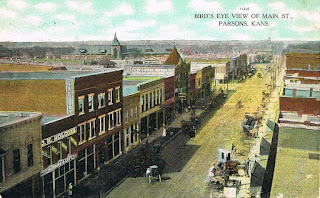 |
Parsons, KS 1909
photo of postcard
courtesy of Chris Cruz via
You know you are from Parsons when ...
(private FB group) |
Anything different than now?
So, a couple of days ago, we saw a photo that was from 1909 and showed a town in southeastern Kansas. A few things stood out. There were a few horseless carriages, but there were lots of carriages. The road was not paved. The town looked western. We will look at one building in the foreground, but the horizon shows a large building and the railroad track sign (cross). This is the photo which is a bird's eye view of old.
Let's look at the large building first. It was the train station for
KATY Railroad (Missouri-Kansas-Texas). Not long after this photo, the building burned down to be superseded by building that lasted until the 1980s. At this time, Parsons was one of the three largest railroad facilities in the U.S. The other two were Los Angeles, CA and Kansas City, which is a Bi-State affair. In the area where we see the railroad crossing on Main Street, the city put in an underpass. A little later, this street had an electric tram running on rails.
Of interest, too, is that Parsons had a huge rail yard with facilities for repair. Tools for the railroad are huge affairs. Yet, this work was being done prior to the assists by hydraulics. So, technology? Yes, we do have that as a theme from an integrative sense with looks at historical aspects with respect to demands, or causes, for change as well as the issues related to research, development and maintenance, as well as use.
As an aside, from Wichita, KS which is west of this area, plane builder, Boeing, shipped fuselages by rail to the west coast. The lonely train out in the huge west is almost an iconic scene. As well as the robberies which are one of the features of a lot of westerns. Some fuselage shipping, later, had to be flown in converted planes due to size. So, we do have a hardware focus; expect to hear about and discuss software, too, especially that which now gets lot of attention.
We mentioned the size of the railroad building. This little town was a major point of transfer. That is, both of goods and passengers. There was a roundabout which was needed back in those days. One sees such with SFO's trolley system. People used to get off and help turn the little thing.
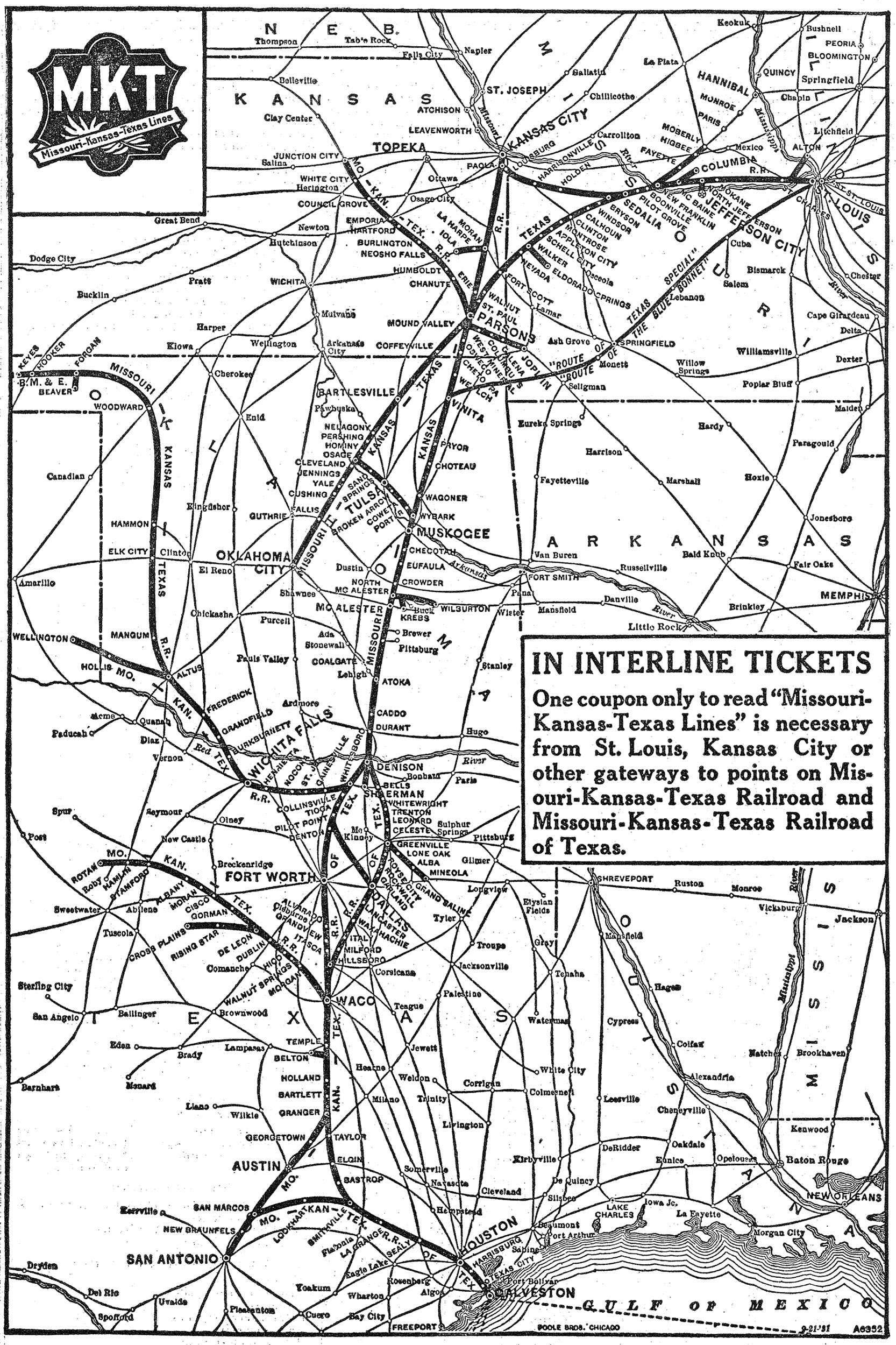 |
| KATY lines |
Another context? Another part of the theme is people and material movement across this wide expanse. We looked at the (stage) coach traffic from
St. Louis, MO to San Francisco, CA and provided details about the trip which dipped down into Texas, went across the southern border, and then back up north from LAX to SFO (using the modern parlance). You see, this little post is a continuing look at technology which we can do using the historical modes of the U.S. Before switching gears, let's look at a map of the KATY which is the heavy line. It carried goods and people from the Gulf coast of TX to St. Louis, MO and Omaha, NB and places in-between.
This is only one example of rail traffic out west. A couple of years ago, while looking at a family history, we saw that one of Ann's uncles was involved in getting a rail line established between Boston and Salem as well as having a similar focus in FL. This was about the same time as the development of the KATY. BTW, John's family was railroad focused, to boot.
So, let's look at people a little. In this photo, there is a building that has the name, Holcomb. That caught our eye since it is a collateral family. Was this kin? As we have made a point of marking further research needed to identify individuals, many of whom turn out to be kin (examples below). Turns out that the initials are D. H. Before looking at D. H., let's look at technology's future.
We see this already with apps and such. But, there will be more structure, at some point, so that we have persistence, consistently, through time. On Wikipedia, most locations will have a section that is titled "Notable people" or "From there" or something or other. In the case of Parsons, several names stood out, as well as Holcomb who is not mentioned. Here are a few.
Based upon our research, we could do this type of thing for any of the locales in the West of the U.S. We already have started with some (say,
Grizzly Adams). Technology will help make this more interesting. How many types of media will we have?
Now, back to D. H. Holcomb. He is the ninth generation from an immigrant who was an early settler of Windsor, CT. This family put their book (Our Banyan Tree) on the web.
David Holcombe (#23766) was born in Ohio in 1850. The family moved further west to IL. The KS Census of 1925 shows that David and his wife had been born in IL. Also, it has his interests to be Real Estate and Insurance which might indicate that he owned the building that had a grocery. David and his wife are in KS according to the 1900, 1910, and 1920 U.S. Census records.
This is cursory as lots more can be researched and written. It is remarkable that we can rely on advances over the past decade to tell fully aspects of stories. Who needs paper? However, having said that, structure is important. We do not live in chaos, ever. For the TGS, Inc., we want to engage in the full coverage related to us and the U.S. and history and more. At the same time, technology requires continual attention. Various aspects of the need are more recognized than others. 'That work is necessary' is a given. 'What work?' is part of the discussions to be had.
Remarks: Modified: 01/05/2023
10/28/2021 -- Added a few links.
12/18/2021 -- 1884 map of Labette County showing the railroads going through Parsons, KS. Besides the KATY, these were the following;
04/20/2022 -- Added link to the image at KU.
04/22/2022 -- Added attribution to the 1909 Postcard: courtesy of Chris Cruz via You know you are from Parsons when ... private FB group
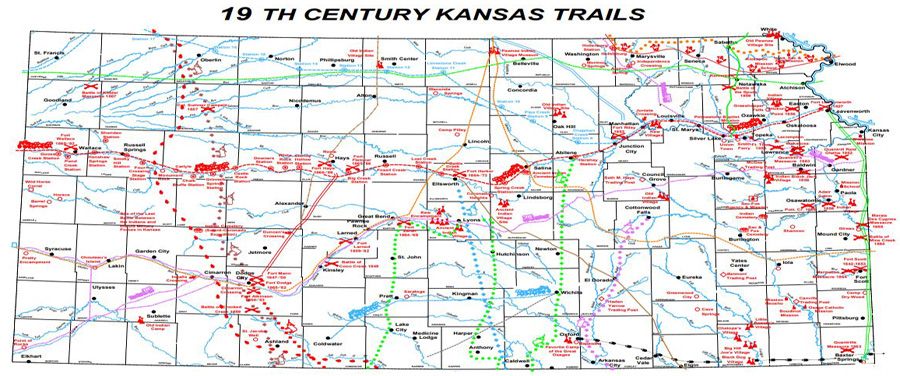
01/05/2023 -- Added link to KDOT map (PDF) that provides historical notes (see 19th Century details).
In the building owned by Holcomb, there is a sign for Hubbard & Lott. We can research this further, but they did get a mention in
The Publisher's Weekly on 23 Sept 1905.