Friday, January 25, 2013

John Goff, Salem Preservationist

In today's Salem Gazette, John Goff writes about "Some old Salem ties to Nantucket" and references the Thomas Gardner Society's website. In the article, John alludes to the peaceful nature attained on Nantucket as opposed to the more cantankerous mode (my usage) in parts of New England.

Earlier, John wrote about King Philip and about the turmoils related to his time. John and his co-author ask what-ifs about more peaceful approaches, albeit that the die seemed to have be cast earlier. Many left the old country to get away from violence (Laud's love of nose splitting and ear cutting off, as an example). Too, it was in the King Phillip's war that the Gardner family lost a son, Joseph, however Thomas and Margaret were already passed on.

Aside: Governor Simon Bradstreet married Joseph's widow, Ann, who had Gov. Simon sign a pre-nup that she drew up. The house is remembered by his name, though.

---

John Goff is one of the many modern descendants of Thomas. He will be the first in a series that we will start on descendants. We first ran across John's work (Salem preservation and newspaper columnist) on an early web search for Gardner which turned up the article on Gardner/White (the post was from 2011).

John's ancestor is Richard who was the third son (Dr. Frank's book) of Thomas and Margaret. Then, John's lineage continues with Richard's son, John, who married Mary Starbucks and, then, Elizabeth who married Stephen Gorham.

---

One planned activity will be to go through John's articles at the Gazette and create an index as part of our bibliography. For instance, this little bit on the Pioneer Village was a great read. It got me to look at Nathaniel's (a Thomas descendant) book, Grandfather's Chair (courtesy, archive.org). The Pioneer Village has a replica of the Great House (Cape Ann) that was taken over to Salem on orders of John Endicott (Winthrop dined there).

Also, John has written of the Salem historians: Joseph B. Felt, Harlan Horton Smith (worked on the Pioneer Village), and more.

This is the Google search result for "John Goff " at the Gazette site. The theme, for the most part, is Salem and early New England. Hence, these articles are of interest to the TGS.

Remarks:

08/27/2022 -- Updated link to John's article. Probably need to check the other links, as well. Finally, added John to the Descendants of Richard. Just for the record, search results on John Goff  (23 posts) in this blog. 

01/07/2019 (updated, 02/08/2019) -- The Thomas Gardner Society, Inc. would like to thank John Goff for his support over the years. We have pulled together a list of his contributions (Gems of Salem).

11/24/2014 -- John featured at anceSTORY archives: Tidal Mills defined by John Goff.

01/25/2013 -- We need to design a framework for doing descendant bios.

Modified: 08/27/2022

Thursday, January 24, 2013

Gardner and Conant families

As we know, Roger came into the Cape Ann area at the request of Rev. John White (more below). We had an earlier post that considered some differences between Roger and Thomas. Too, the last Beacon issue looked in a Annals format (we're going to use this for awhile) at several things, one of which was John's (as in, Endicott's) relationship with Thomas (as in, John knew that Thomas was a "Mr" and related to him thusly). Thomas and Margaret were resident in the house when John had it knocked down and brought over to Salem.

---

Aside: By the way, we're going to document this more thoroughly on Wikipedia - Great House (Cape Ann). We have John Goff's expertise available to assist us. This house was the first of its kind in New England.

---

Uncle?
Now, there are relationships between the families of Thomas and Roger. Seeth married Roger's son, Joshua. No doubt, there are others. Let's look at one that is interesting. Take Rev. John White (please). His sister, Martha, married William Cooke. Then, their daughter, Elizabeth, married William Walton. Elizabeth and William and their kids came over to New England. And, their daughter, Elizabeth, married Lot Conant.

This would mean, given the association mentioned by John Goff (in his article), that the Elizabeth who married Lot was a grand-niece of Thomas. However, according to a UK page, dealing with the Dorchester Company, the sister, Elizabeth, of Rev. John White who married Thomas Gardner did not have a son named Thomas.

---

Aside: From an outsider's view, Rev. John White didn't act like much of an uncle, or did he? If he were, he sure sold his nephew done the river, IMHO. (See Remarks 06/15.2013)

---

As you can see by the links, we are, mostly, in an acquisition'l mode. The intent is to find out all of the sides and their supporting material. The hope would be to find some reasonable story that has good support. Now, when it is a case that is not so strong, we can make proper conjectures. To wit? About the number of wives of Thomas: we say two.

The beauty of newer methods (disparate view bridging in the cloud) will be to allow multi-faceted looks at something. We don't live in a black/white world. Yet, even fuzzy approaches can (must) de-fuzzify now and then. How to present the material with the proper richness will be a continuing challenge.

---

Aside: There are many such questions to work on.

Remarks:

02/06/2019 -- Last night, the 'Roots' show (PBS, Gates) reported on Mike Stahan, a TV personality. Mary Gye came up with descendants of a mix of Essex County families. Her granddaughter married Samuel Walton whose father was a nephew of the good Rev. Samuel's sister married the son, Lot, of Roger Conant. Lots to look at regarding this particular tree (southern moves, etc.). For now, a brief mention with a graphic.

09/05/2013 -- Nice site with information related to Rev. John White.

08/22/2013 -- The start of a look at what was what in early Salem (and New England) as far as Gardners is concerned.

06/15/2013 -- Was there a Thomas and a Thomas? -- About a funny uncle, I'll admit an err. Based upon what I've seen in researching for the next Beacon issue (and even from personal observation), uncles are not saints, many times.

01/25/2013 -- John Goff is noted for his Salem preservation efforts.

Modified: 02/06/2019

Monday, January 14, 2013

Blog of the year, 2012


Earlier today, we got notice of the TGS blog being submitted for the award by Heather at Nutfield Genealogy (thank you, Heather Rojo Wilkinson). I have returned to the Nutfield blog many times while trying to untangle some of the genealogical knots that seem to lurk about.

---

The award is sponsored at the following link; the rules are posted at the link (and are provided below). For item 2, look after the rules.

         http://thethoughtpalette.co.uk/our-awards/blog-of-the-year-2012-award/

Blog of the Year Award 1 star jpeg


1 Select the blog(s) you think deserve the ‘Blog of the Year 2012’ Award
2 Write a blog post and tell us about the blog(s) you have chosen – there’s no minimum or maximum number of blogs required – and ‘present’ them with their award.
3 Please include a link back to this page ‘Blog of the Year 2012’ Award – http://thethoughtpalette.co.uk/our-awards/blog-of-the-year-2012-award/   and include these ‘rules’ in your post (please don’t alter the rules or the badges!)
4 Let the blog(s) you have chosen know that you have given them this award and share the ‘rules’ with them
5 You can now also join our Facebook group – click ‘like’ on this page ‘Blog of the Year 2012’ Award Facebook group and then you can share your blog with an even wider audience
6 As a winner of the award – please add a link back to the blog that presented you with the award – and then proudly display the award on your blog and sidebar … and start collecting stars…
---

The following list contains my nominations.
Remarks:

11/23/2013 -- Need to start a list of history/genealogy blogs: Rooting for Ancestors,

08/26/2013 -- Blog with subjects related to Thomas and his descendants.

03/02/2013 -- Engineer memes is at blogspot.ca.

02/21/2013 -- Mark's blog has an interesting list of posts related to forebears prior to the 'puritan migration' that will motivate a few here (next post): Shakespearean ancestors. Evidently, Downton Abbey (I have not watched it, yet) has people thinking of the little realm of our ancestors. We can use the meeting meme (ala the 1692 turmoil) to cover the gamut from William's bit of ambition involving all sorts of inter-family squabbles. You see, Thomas' mixture (genes/memes) encapsulated that (as does all of our glorious selves, in one way or another). His life and choices exemplify much for us to try to know and understand.

02/07/2013 -- Found another blog of note: Gene expression (post at this time had a photo of John Quincy Adams). Note the criticism of The Seven Daughters of Eve. As I find them, I'll add 'em here.

Modified: 11/23/2013

Tuesday, January 8, 2013

TGS Forum

Note: 05/24/2017 -- Database problem. Most likely will shut this down and move to another technique.

Note: 03/02/2013 -- See Remarks this day, below.

To facilitate discussions, and activities, related to the 400th anniversaries and more, we have added a bulletin board to the TSG site. There is an easy registration step (or, browse and post as guest) including one little bit to verify that the one registering is a person (inhibit spamming).

For now, no moderation is planned; we assume the usual protocols of good conduct.

---

There are two threads now: birth order of the children (see the image which is cut from Dr. Frank's and Anderson's books) and initial entry of Thomas and Margaret. But we expect this list to grow. Anyone can add a thread.

It is expected that some facility like this can be used to coordinate a group's interaction and to keep things moving forward effectively.

Remarks:

05/21/2014 -- Real progress comes in slow, small steps?

07/11/2013 -- Looking at website improvements, this date.

03/02/2013 -- Putting in the agreement didn't help. Evidently, people don't read the things. So, the spam continued. As of a few days ago, the automated registration has been disabled. New accounts can be obtained by mailing jmswtlk[@]thomasgardnersociety[.]org. Specify desired ID and particulars about your interest in the TGS. Namely, family and friends are welcomed.

01/24/2013 -- Due to spam registrations, the TGS BB requires an approval. That is, go to the site's registration page, check that you read the agreement (note, for family and friends of Thomas and Margaret () Gardner of Salem), fill in the needed blanks, and then we'll get a notice. As mentioned in the What's New at the TGS BB, we intend to have a persistent site. However, there will be improvements as we go along. Data will carry forward.

01/12/2013 -- Split TGS BB (forum) into public (can be read by guests) and private (requires registration and login) areas. For instance, the Social category has Water Cooler (public) and Break Room (private).

01/11/2013 -- Added link to TGS from FamilyTreeCircles. Found this while searching for Rachel, proposed sister of Thomas, after seeing her mentioned in another blog (Turn the Hearts). I had seen her in early browsings, but today I decided to look in more details.

01/10/2013 -- Added in a "water cooler" board, for general topics, a what's new board, and renamed the working category to Family focus. Some of this ought to be members only, perhaps, leaving only overview items as public.

01/09/2013 -- A BB is fluid, essentially. A blog is less so. One would expect that we would take information that comes in via the BB and structure it, with other information, into other formats. How this might be done will be discussed further, at some point.

Modified: 05/21/2014

Sunday, January 6, 2013

400th anniversaries

It's hard to believe that the 400th is right around the corner; it's close enough that we could start counting down now with 10, ... Also, which of the 400th anniversaries will we feature?

We could start with the marriage of Thomas and Margaret, though we don't know the date. We do have the birth years (approximate?) of Thomas, George, and Richard that would be prior to the Cape Ann venture. One goal might be to get the arrival time a little more clear (I've seen quite a range of guesses) even if we can only identify the time that has the most support (to be discussed).

For starters, the below list is to be taken as cursory (see TGS site for an early start on this), for now. There is a whole lot that could be done; and, a lot needs to be done once decisions are made. The bullet order does not imply priority. Some things may need more immediate attention than do others.
  1. Set up a mailing strategy for Gardner's Beacon and for e-mail interchange and discussion, perhaps using a message center for the latter. 
  2. Given Dr. Frank's effort at publishing 100 years ago (we cannot thank him enough), our effort now ought to be to establish a cyber presence for Thomas and Margaret that is persistent, well cared for, and known to be the best source of information going forward. The current web-site (TGS.org) is only a minor step. There will be technical discussions, related to the approach to take, in regard to resources, trends, and best approaches. We are talking more than genealogical studies (we like that the NEHGS has both "H" and "G").  
  3. Document, thoroughly, the events related to Cape Ann and Salem in so far as they pertain to Thomas and Margaret. Some of this may be reasonable conjectures based what will be known once all the material is pulled together and organized. One might say that Anderson's (et al's) Great Migration (six pages for Thomas and family) is a little peek under the covers (so to speak). 
  4. Start with the first few generations (three to five) and fill in the tree for the children of Thomas and Margaret (early attempt at this for two generations).
  5. The prior bullet (#3) was top-down. From the other direction, provide a means to collect information about current descendants, their stories, and tales of the sagas of their intermediate ancestors. Again, there are many ways to do this. Develop the descendants list further. 
  6. In regard to the prior bullet (#4), present the coverage maps like one sees nowadays (but, with a way to control the timeline). Link this with the effort of the next bullet.  
  7. Extending the idea of the first bullet (#1) and the prior (#5), develop a "game" approach (let's say, non-1st world (such as, Second Life) and educationally focused) that will allow Thomas and Margaret to be spokespersons for those times and more. This notion pertains to lessons to be learned from the experiences of those two (and, some of their cohorts) that are relevant to today (see Backbone series, as one person's opinion). One motivation might be to get the younger generations enthused about these "dead" people from their (ours') pasts. However, who knows what might flower out of new research efforts?  
  8. Accomplish various tasks related to this type of organization (membership, 501(c)3, application process, research support, scholarships, etc.). 
  9. Establish a regular publication schedule for Gardner's Beacon with themes determined in advance to allow for article calls. 
  10. Gardners and Gardners will be of continuing interest. Associated with this, summarize the disparate information that one can find, provide an overview, and maintain the data going forward. This, somewhat, overlaps the first bullet (#1). Support other Gardner efforts (see #12, below). 
  11. Organize, and maintain, a bibliography that facilitates efforts for the first (#1) and the prior (#9) bullets.  
  12. Push the window backward from the Cape Ann (1623/1624) arrival in a manner that carry forward. For starters, collect everything done to date (books, family information, websites, ...) and handle much like the Gardners and Gardners effort (prior bullet - #9). 
  13. DNA anyone (backgroundGardner project)?
  14. Provide for, and support, regular maintenance of TGS information, such as testing for missing items (and a whole lot more), on an on-going basis.
  15. ...
There can, no doubt, be more items added to this list. For instance, having a place for regular discussion would be nice. Too, a common method for submitting trees ought to be facilitated, at some point. The idea, now, is to start small and to build incrementally. Hopefully, if this is done, more or less, correctly, there would be fewer false steps.

Of course, technologies will change. Bridging these types of changes over time is an open issue. Perhaps, after the bursts of knowledge of the last 100+ years, or so, settles down, there will be better effort at preserving states of knowledge.

Actually, one talent that we humans have (not yet replicated by the artificial, yet) is creativity which can span across seemingly endless states without getting lost. So, our intent will be to foster the human side of creativity going forward. Perhaps, that might be one lesson of Thomas and Margaret.

Remarks:

12/30/2018 -- The 400ths will be one theme next year.

10/26/2018 -- Review the task list (above) and general status.

Recent 400ths 
07/11/2013 -- Looking at website improvements, this date.

01/08/2013 -- Added a forum to facilitate discussion, etc.

01/07/2013 -- There are many anniversaries to plan for. Also, to the above list, we ought to firm up the order of birth. Let's say that nine children is the agreed upon number. There will be a post on this, soon.

01/06/2013 -- Need to figure a good e-mail strategy that doesn't involve reply all.

Modified: 12/30/2018

Thursday, December 27, 2012

Clamorous bunch

Thomas sticks out because of the dearth of information about him. He did not leave behind anything of a glib, or even querulous, nature. No, he was there and effective; and, he left his progeny. We have already mentioned that being free with words was a trait that seemed to come to fore here, in the first land of freedom.

Hence, Thomas can serve as a proxy for our look backs. Just like the "WWJD?" question, we can ask: what did Thomas think?

---

On reading Thomas Prince yesterday, I marveled at his scholarship and energy. His 1736 publication (Vol. I of the Chronological History of New England) had several pages of references. Luckily for us, Prince had read Rev. Hubbard's manuscript (finished in 1680, it was almost lost in the mayhem related to the tax issue - at Hutchinson's house which was trashed and burned) and used it.

Hence, we have the first reference of the role of Thomas and John (Tylly, of course) in a look back that was only 100 years after the fact. Of course, all sorts had their memoirs. I'll keep looking for the first reference, but, right now, it seems to be Hubbard (printed first by Prince).

Now, coming over to this land brought out several latent characteristics that had evolved over centuries. Think of the youngsters now running off to college and parties (and dire straits, many times). Same sort of thing; yet, some were more mature about it (hint, Thomas and his ilk). Others took their new-found power a little to far (despots, essentially - who? do I have to enumerate the whole set for you?).

---

I will redo Prince's bibliography in a modern format. It's really impressive. Many of these are in digital form, hence we can read them (so, we'll link to the on-line material).

But, looking at his work reinforced some notion that I've rolled around [in my mind]: you have to go back to the original sources, folks, to see what the person said by reading it yourself. As we would know from information theory, we have people expressing their opinion, then that opinion generates a retort (many times the original source is not reviewed to see what is what) and so forth, ad infinitum (it seems). We have to go back to the original source (which implies having it available and not just quoted by some later dude -- now, there may be additional information about motivation, milieu, etc., which all can be facilitated with the internet -- listening Zuck? -- what is this crap of claiming territory and making oodles of money -- yes, the cyber realm's landscape is being as screwed up as was the 1st world's).

---

The coming Gardner's Beacon issue will provide, hopefully, a new start on some of this stuff. The original basis will be minimal (somewhat).

---

The clamor accelerated with the advent of New England's reality, prowess, (in Thomas Prince's work, the scope includes all, not just the northern part that was started by the errant Pilgrims of 1620). The clamor reached some peak around the War of Revolution. However, the internet age has caused a worldwide surge (that is, beyond the huge amount daily captured in the Congressional Record). Lord help us (as in, who can eat or wear this vaporous thing that does not even have any semblance of being? -- ah, money as an analog).

Remarks:

01/01/2013 -- David Goss' talk at the 1999 Essex Society of Genealogists gives a perspective that also motivates. See the TGS bibliography.

Modified: 01/01/2013

Tuesday, December 25, 2012

Gardner's Beacon, Vol. II, No. 6


See Vol. II, No. 6 of Gardner's Beacon for a look at the legacy of Thomas and Margaret () Gardner using an Annals format and being accompanied by a bibliography (with links to digitized versions of references).

---


In 1995, the Great Migration series had its first publication. Over the next few years, the early settlers (1620-1633) were covered in three volumes. If we take the first three "governors" and their coverage, we have this: Thomas Gardner (six pages), Roger Conant (eight pages), John Endicott (seven pages). This publication covers what is known about the settlers at this time.

As such, though, there is a lot of material that is not referenced. Too, a look back, such as the Great Migration one, can cover 1000s of people and cannot get into as much detail as we might want. We have to go elsewhere, and, frankly, the sum total of information that I have seen can be less than clear, for many reasons. One such controversy is how many wives that Thomas had. There are others.

For instance, on March 20, 1999, a talk at the ESOG (Essex Society of Genealogists) by David Goss looked at the Old Planters of Beverly (TEG, Vol. 19, pg. 123 -- our earlier take on the subject in 2011). He described how the term came about and to whom it applied. From the Beverly-group's perspective, the names are familiar as they've been used in many papers and books (Conant, Balch, Trask, Woodbury, Palfray). These were, in other words, the stalwarts of John White or the group led by Roger Conant (Reminder: the Beverly group did not get their land until 1635 - we need to talk about the time from 1624 up til then, more or less).

Along this same theme, we saw, in 1899, the founding of an Old Planters Society whose membership included those who had ancestors who came before 1630. That effort was led, in part, by Dr. Frank. A. Gardner. Dr. Frank A. is noted for his books on Thomas Gardner and his descendants using material that he had gleaned through a lifetime of research. It is of interest, that in the early 1900s, the group seemed to be a Balch/Gardner reunion (Benjamin Balch's/Sarah Gardner's descendants). The latest events have a flavor of the History of Beverly. The 1899 group talked about the injustice of history overlooking these early planters and wanted to correct the matter, ostensibly before the 300th anniversary. We're preparing now for the 400th.

---

David's paper, which I ran across recently, was the latest find during a three-year search and review, by the blogger, of all material related to the Cape Ann group. This long effort, essentially, looked in all corners and created a huge pile of material (searched with a very-wide net). Now, the task is sifting through the huge pile, developing a bibliography, laying out a timeline, and building a view that can go further as support for future research. That motive of this work is to honor Dr. Frank's work and to present a coherent, and as complete as we can, view of Thomas.

Too, many conjectures have been presented which do not fit the bill, otherwise there would not be the controversy (unless one expects that these types of things are not resolvable).

---

The current issue presents the material in a timeline by year, up until the present. In doing so, it hopes to show a view that makes sense. The timeline is not complete; rather, think of it as an outline from which we can define research projects that will clarify, fill in, information. If done correctly, this type of timeline would become more and more strong such that future people with interests in Thomas and Margaret can use it as a launch point.

That brings up a new view though. Thomas' crew put together a house their first year. Too, they did come prepared and were successful in establishing themselves. The only failure was not having sufficient output to send back to the capitalists in England. What White may have wanted was for them to send what they needed to sustain themselves, but reasonable folks do not do that without the threats of the taxman or strong arm (those who came here were not serfs, in other words).

When Conant showed up, he didn't find starving people. He found a boisterous group. The use of insubordinate shows White's failure (hey, the descendant of Thomas has White on the tree more than once). The effort was not a military expedition. It was a plantation building effort.

Here is the thing, though. When Conant and his group went down to Naumkeag, it was not an all-in-one trip. Whoever thought that has not had to deal with the real world. We're talking a trip that could be taken by a good man in a day. By water, the trip could be less in the right conditions (look at the image which shows an entry from Winthrop's diary - courtesy of Judy Jacobson - in which he talks of going to Salem, eating, then going to Cape Ann, for dessert, so to speak). Too, Thomas' group had established themselves at Cape Ann (which is a real nice place, by the way). There was the house and other dwellings. They had gardens. They had cattle. They could fish. There was game. Who the heck sees this as failure?
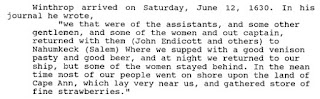
The movement over to Naumkeag took time and many trips. What ought to be considered is that Thomas had a presence at both places, but he was principally in Cape Ann. He could take care of (and feed) himself and his family very well. Now, when Endicott showed up and pushed Conant aside, he saw Thomas in the Cape Ann house. He liked the house and had it moved to Naumkeag.

Too, though, Endicott knew that Thomas was of the "Mr" variety. Hence, Endicott wrote about him (the 1629 meeting mention). Due to the lack of "press coverage" as we expect nowadays, Thomas might be considered peripheral by some, but so what? He was taking care of his own. Most likely, he helped other people, too. And, why would he follow Conant? Too, as said before, Thomas' proof of being is his progeny. And, being, folks, is still the reality (we have seen plenty examples, of late, of effective people who do not announce their deeds prior, or even ex post facto, to accomplishment).

Thomas was not a freeman (as if he needed someone to set him free) until 1637. He joined the Church the year before. But, he was signing things, like land grants, before this. In other words, he and Endicott got along, so Endicott gave him some responsibility. But, as we know how people are, the Church people noted that Thomas hadn't shown up (in modern parlance, took a boondoggle to Cape Ann to look at the crops when service time came around - okay?) so they had to rope him in. Also, Thomas knew that his kids would have to be of the social element in order to have any success. So, he deigned to join.

Not long afterwards, though, he married a Quaker. Do we hear of anyone threatening Thomas (Endicott would know better!) on this? We have not seen such documented. And, this type of thing would have been recorded. Also, it was not that Thomas was a bully causing people to fear him. Rather, his stature (I would presume from what I know of Gardners) was above normal; he have a solid, and large, character; and he was a man's man of the peaceful type (the American Indians loved him).

In other words, the preeminent individual so loved by Emerson (in his mind - by the time of Ralph Waldo, too many of the elite had ruined things for the rest - that is part of the Thomas story) was here within the first generation (actually was the first generation).

---

That first group, all of them, had remarkable characters. They did not fail at Cape Ann. When Endicott got here, he did not find starving, helpless people. But, guess what? Not long after Endicott arrived, here came boats of people (too many) who swamped resources. At this time, Thomas would still have been house-sitting where they were well-provisioned. He probably helped move the great house (1628/1629) from Cape Ann to Naumkeag (at least, he probably was able to do this - of the many that we read about, they would be about as effective as a slug for any useful purpose -- unfortunately, history's details are about such and not those who can get, know how to get, things done).

The winters of 1628 and 1629 were dire due to the influx of the unprepared, and the results were catastrophic. We'll have to touch on this in our research. By the time Winthrop arrived, though, things were going great again, though, due to efforts of people like Thomas.

---

Aside: Salem, the wallflower? This little city ought to be as beloved as is San Francisco, for many reasons. Why is it not?

References:  see Sources and Bibliography (further delineation, soon)  

Remarks:

03/27/2019 -- Image added to the index on our portal to truth.

06/15/2013 -- John Farmer wrote that Thomas was from Scotland. Origins are, and will be, a focus.

01/25/2013 -- By the way, we're going to document this more thoroughly on Wikipedia - Great House (Cape Ann). We have John Goff's expertise available to assist us. This house was the first of its kind in New England.

.01/08/2013 -- Added a forum to facilitate discussion, etc.

12/30/2012 -- 2nd edition, with changes, published today (see Afterthoughts & Modifications for this volume).

12/29/2012 -- In Afterthoughts & Modifications, mentioned the David Goss talk in 1999.

12/29/2012 -- Beacon issue uploaded with the start of a Bibliography with links to digitized versions of reference material.

12/26/2012 -- Someone else had the same idea: Balch Leaflets (1896): That Cape Ann was left utterly deserted at this time is very improbable; it could be plainly seen from their new abode and was distant but a few hours coast-wise by boat or canoe. ... There was a frame building there of considerable size and other property that demanded care. (This particular leaflet is dated 1877)

12/25/2012 -- The issue will be completed this week; this advance notice is a Christmas gift to Thomas descendants, and friends, who wondered about the times after Cape Ann.

Modified: 04/23/2021